


Mask Elastic
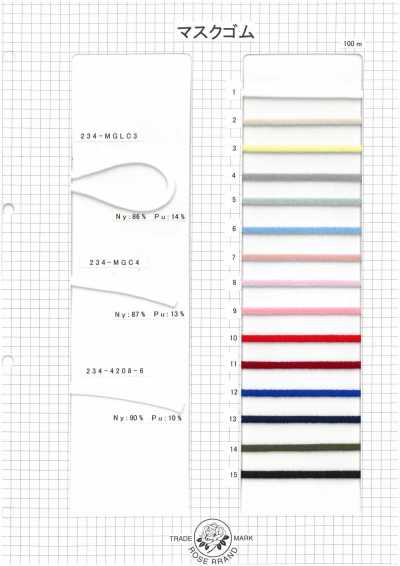
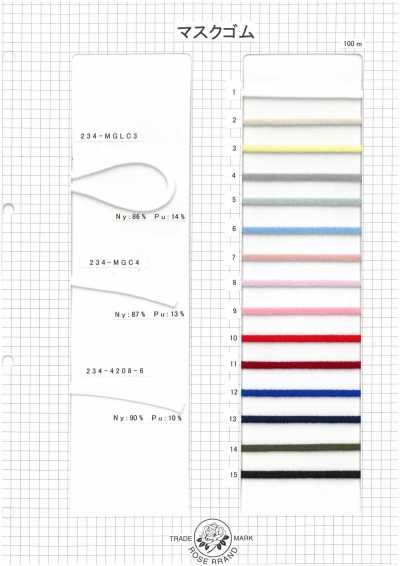
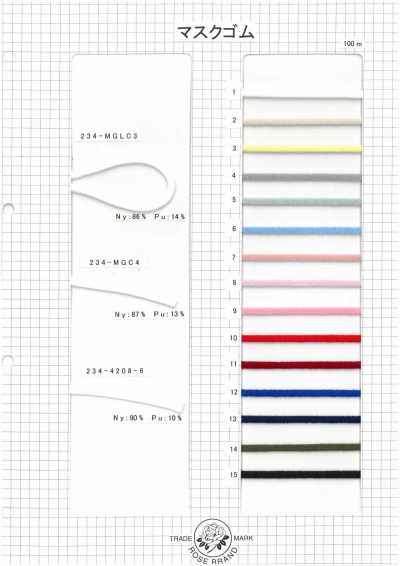
Mask elastic is a soft, stretchable narrow elastic cord or tape attached to both sides of a hygiene mask body and looped over the ears to keep the mask in place.
Contents6 sections
Definition and Overview
Mask elastic is a stretchable material used for the ear loops of nonwoven masks and cloth masks. It is required to hold the mask on the face while reducing pressure on the ears. Flat elastic types are characterized by the larger contact area they can provide against the ears.
It is also called ear elastic or mask elastic. Like flat elastic and round elastic for apparel, it has stretchability, but mask elastic is distinguished by being selected with special consideration for skin feel, lightness, and the level of tightness in ear-loop applications.
Materials and Structure
In many cases, it is made by covering or knitting elastic yarns such as stretchable polyurethane with yarns such as polyester, nylon, or cotton. The material of the covering yarn and the condition of the fuzz affect softness, appearance, and how it feels against the skin.
Its structure is divided into woven elastic, knitted elastic, and braided elastic. Woven elastic tends to hold its shape relatively well, while knitted elastic tends to be softer and more stretchable. Braided elastic is often made in a round cord shape, and the contact against the ear varies depending on the cross-sectional shape.
- Flat types make it easier to secure the width that touches the ear, and are also used for standard nonwoven masks.
- Round types are used as thin ear cords and are also suitable for styles that are tied or adjusted for length.
- Those with a brushed surface or a soft knitted texture are considered for applications that emphasize skin feel.
How Width and Stretch Are Expressed
When selecting, check the width, thickness, finished length, and how much it stretches. Width is shown in millimeters, and even with the same width, the feel against the ear and the tightness differ depending on thickness and structure. The use feel cannot be judged by whether it is flat elastic alone.
Stretch is checked by the elongation ratio, which shows how far it can be stretched relative to its original length, and by the elongation stress, which is the force needed to stretch it. The elongation recovery rate, which is the property of returning to the original length after being stretched, is also important for masks used repeatedly.
Main Applications and How to Choose
The main applications are the ear loops of nonwoven masks, cloth masks, and 3D masks. Depending on the shape of the mask body, the intended wearer, and the ear cord attachment method, choose the flat or round type, width, color, and texture. For children or for long-wear use, it is necessary to consider avoiding excessive tightness.
Before mass production, make a prototype sewn or heat-bonded at the actual length and check the fit. Since the breathability and three-dimensional shape of the body also affect the fit, it is important not to determine the dimensions based only on the stretch of the ear loop itself.
- Check the balance between pressure on the ears and resistance to slipping.
- If sewing, check for damage from needle holes and for seam shrinkage.
- If heat-bonding, confirm in advance any deformation caused by heat and the bonding strength.
- Also check color differences from the body color and differences in color or texture between lots.
Handling and Durability
Mask elastic containing elastic yarns may change in stretch and recovery due to long-term stretching, ultraviolet light, heat, sweat, sebum, and detergents. Especially for cloth masks that are washed and reused repeatedly, confirm the elongation recovery after washing.
For storage, avoid leaving it in a strongly stretched state, and avoid high temperature and humidity as well as direct sunlight. Whether it can be washed and how it should be dried depends on the material and structure, so confirm the material specifications and ensure they are consistent with the product's care label.
Frequently Asked Questions
Should I choose flat elastic or round elastic for mask elastic?
If you want to reduce pressure on the ears, flat elastic, which can provide a larger contact area, is a candidate. On the other hand, round elastic is used for thin ear cords and styles that are tied and adjusted. However, the feel of use is also affected by width, thickness, elongation stress, and length, so it is important to check with a prototype.
What checks are needed for cloth masks that can be washed?
Check whether the elastic remains stretched and does not return after washing, becomes stiff, or develops fuzz on the surface. Also check the strength of the sewn attachment to the body and the length of the ear cord after washing and drying, and determine specifications that are suitable for the intended care method.





