High-tenacity Yarn
High-tenacity yarn is yarn with higher tensile strength than yarn for general use, used in applications that require durability in seams and sewn sections.
Contents7 sections
Definition and Overview
High-tenacity yarn is not a fixed material name or yarn construction name, but a term for yarn with increased strength to resist breakage. In sewing thread for apparel, it may be characterized not only by high tensile strength but also by low elongation and stable sewability.
Even with high strength, the durability of a sewn product also depends on seam design, textile strength, load on the needle hole, friction, and other factors. For this reason, high-tenacity yarn is evaluated not only by the strength of the yarn itself but also by how it combines with the performance required for the product.
Materials and Twist/Structure
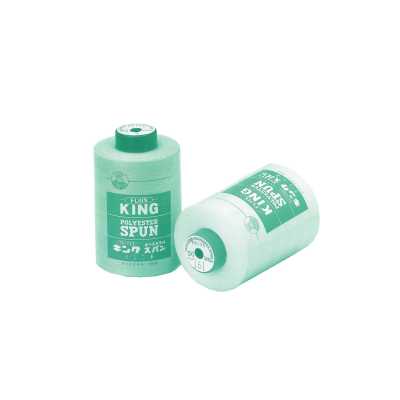
High-tenacity yarn is often made from synthetic fibers such as polyester and nylon. Some use filament yarn, while others use spun yarn made from short fibers. Strength, stretch, and surface characteristics vary depending on the material, fiber properties, spinning method, heat treatment, and other factors.
Twist binds the yarn together, making it easier to handle and affecting fuzziness, abrasion resistance, and sewability. Increasing twist does not simply increase strength; if the amount of twist is excessive, the yarn properties and behavior during sewing change, so design suited to the application is necessary.
There are also yarns made by twisting multiple yarns together and core-spun yarns in which fibers cover a core yarn. Because strength, fuzziness, luster, abrasion resistance, and seam appearance differ depending on the structure, it is important not to judge the structure from the high-tenacity label alone.
How Thickness Is Expressed
The thickness of high-tenacity yarn is indicated by counts, decitex, denier, or the nominal count of sewing thread. However, the relationship between the number and thickness differs by notation method, and even the same number cannot be compared if the unit or construction differs.
Nominal count is a designation established for ease of handling as sewing thread, and it is not a value that directly indicates actual thickness or strength. When placing orders or setting sewing conditions, check the specifications for the nominal count as well as the material, construction, yarn length, tenacity, recommended needle size, and other details.
- In constant-weight systems such as cotton count, a larger number generally means a finer yarn.
- In constant-length systems such as decitex and denier, a larger number generally means a thicker yarn.
- Nominal count notation and equivalence relationships may differ depending on the type of yarn and the supplier.
Main Applications
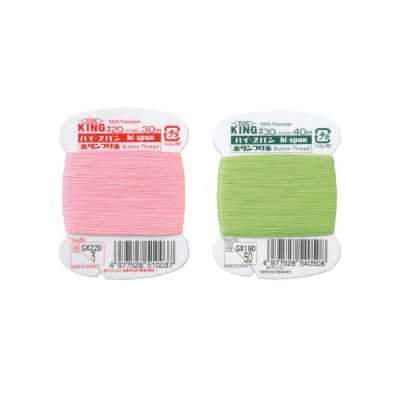
It is used for apparel, workwear, denim products, bags, parts of shoes and leather goods, and other items where seams are subjected to repeated force or friction. It is also an option for applications where load is concentrated locally, such as button sewing, bartacking, and heavy decorative stitching.
For products that undergo washing or post-processing involving friction, the load the yarn receives during processing must also be considered. However, suitability varies depending on processing agents, temperature, time, and product specifications, so confirm with sewn samples and processed samples before mass production.
Selection and Sewing Notes
When selecting, check the required seam strength, color match with the material, surface luster, and resistance to washing and post-processing. If the yarn alone is extremely stronger than the textile, the textile side may tear or stress may concentrate around the needle hole when strong force is applied.
Set a sewing machine needle, needle plate hole, thread tension, and sewing speed that suit the thickness. With thick or stiff yarn, a small needle hole may cause thread breakage or heat generation, and if the needle is too thick, it may leave conspicuous needle holes in the textile.
To prevent seam puckering, skipped stitches, thread breakage, and seam shrinkage, carry out trial sewing including the combination of upper and lower threads. Especially for stretch textiles, confirm whether the thread elongation and sewing specifications can follow the stretch of the textile.
Differences from Similar Terms
High-twist yarn is a term for yarn with a large amount of twist, whereas high-tenacity yarn is a term focused mainly on strength performance. Strong twist may give surface texture and firmness, but being high-twist alone does not mean high-tenacity yarn.
High-tenacity yarn can be any of filament yarn, spun yarn, or core-spun yarn. These are terms that indicate the form of the fiber or the structure of the yarn, and the classification axis differs from high-tenacity, which indicates strength performance.
Frequently Asked Questions
Can high-tenacity yarn be used for any textile?
Not necessarily. For thin or weak textiles, strong yarn may concentrate load around the needle hole, causing textile breakage or puckering. Choose by checking with trial sewing according to the textile strength, thickness, stretch, and sewing specifications.
What is the difference between high-tenacity yarn and high-twist yarn?
High-tenacity yarn is a term that emphasizes performance such as tensile strength. High-twist yarn, on the other hand, refers to a structure in which a large amount of twist is applied to the yarn. Twist affects yarn strength and texture, but high-twist alone cannot be judged as high-tenacity.
For high-tenacity yarn, does a larger number mean a thicker yarn?
It depends on the notation method. In cotton count and similar systems, a larger number generally means a finer yarn, while in decitex and denier, a larger number means a thicker yarn. Do not compare the nominal count of sewing thread by itself; check the unit, material, construction, and specification sheet.