


Calico
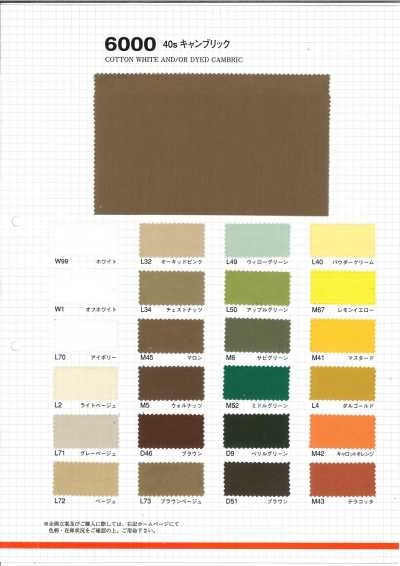
Calico is a plain-woven lightweight to medium-light fabric made mainly from cotton yarn, used for shirt fabrics, linings, and other accessory applications for its smooth surface and ease of handling.
Contents6 sections
Definition and Overview
Calico is a plain-woven fabric made mainly from cotton. Depending on yarn thickness, weave density, and finishing such as bleaching or dyeing, its thinness, stiffness, and appearance can vary widely. For that reason, it is important to confirm the specifications rather than judging quality by the name alone.
Bleached calico may be called cambric when it is given additional finishing such as glazing and sizing. However, calico and cambric are not synonyms; cambric is a term that includes features from the finish.
Feel and Function
It has the uniform, straightforward surface characteristic of plain weave, and is generally a fabric that is easy to keep lightweight and breathable. When made primarily from cotton, it has absorbency and is relatively gentle against the skin, though the hand feel changes depending on thickness and processing.
In thinner specifications, sheerness may appear, so for light-colored garments it is common to consider layering, linings, or combining it with undergarments. Pieces with sizing or resin finishing tend to feel firmer, and the texture may change after washing.
Main Applications
It is used for garments that take advantage of its lightness, such as shirts, blouses, children's clothing, and pajamas. It is also used for pocketing, facings, interfacing, and toile material for prototypes. Depending on the material, fabric weight, and finish, it can be used year-round, especially for spring and summer applications.
- Shirts, blouses
- Reverse side for dresses and skirts
- Nightwear, children's clothing
- Accessory fabric, prototypes, craft applications
How to Choose and Handling Notes
When selecting, check the blend ratio, fabric weight, density, fabric width, sheerness, and whether there is any finishing. Even within calico, thin grades are light and easy to wear but can present issues with strength and transparency, while medium-thin grades are easier to handle during sewing and provide a moderate sense of security.
Because cotton-based fabrics may shrink when washed, pre-wash or conduct a wash test before mass production and reflect the shrinkage rate in the pattern. Before cutting, straighten the grain, choose needles and thread suited to thin fabrics during sewing, and check for sewing shrinkage and puckering.
Differences from Similar Terms
Sheeting is also handled as a cotton plain weave, but it is generally coarser than calico and is often used for prototypes and supply applications. Since actual classification can vary by trade usage, compare yarn count, density, and fabric weight rather than the name.
Broadcloth often refers to shirt fabric woven tightly with fine yarn and finished smoothly, and it differs in that it tends to have a finer, more refined appearance than calico. Cambric refers to a bleached thin calico finished with added sheen and firmness.
Frequently Asked Questions
Can calico be used instead of broadcloth?
Depending on the application, yes, but they are not always equivalent. Broadcloth is generally made with finer yarn and higher density, so it tends to have a smoother, more refined surface. Calico has a wider range of specifications, so compare fabric weight, density, sheerness, and the feel after washing when deciding.
Does calico shrink when washed?
Calico made primarily from cotton may shrink or change in texture when washed. The degree of shrinkage depends on the yarn, density, finishing, and washing method. Before commercialization, conduct a wash test under conditions close to actual use, and if necessary, perform pre-washing or dimensional adjustment.





