Welded Ring
A welded ring is a ring-type hardware component made by bending metal wire into a loop and closing the seam by welding or brazing, used to connect tape, cords, or belts.
Contents6 sections
Definition and Overview
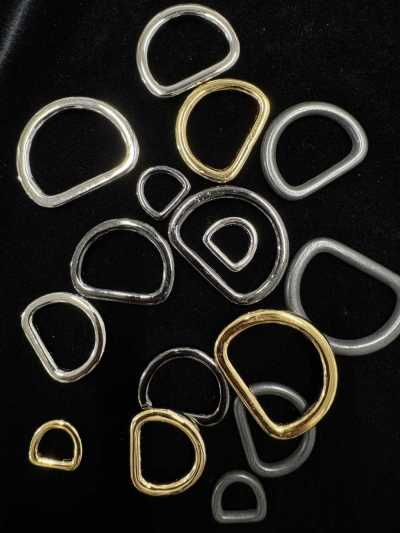
Welded rings are metal fittings made by joining and closing the joints of wire rings that have slits. They come in various shapes such as round, D-shaped, and square, and are used as components for connecting, suspending, and adjusting the length of tapes or strings. The basic characteristic is that the joints are closed.
"Kan" is a general term for ring-shaped or frame-shaped metal fittings. "Welded Kan" is not a shape name but a term that describes the processing and structure of the joint, and there are also welded versions of circular ring and D-rings.
Materials and structure
In most cases, metal wires such as iron, brass, and stainless steel are used. Strength, weight, corrosion resistance, and appearance vary depending on the material, wire diameter, shape, and finish of the joints. The surface may also be finished with plating or paint.
The joints are joined together by welding or brazing. Compared to double rings with open joints, this structure makes it less likely for tape or string to slip out of the gap. However, the strength of the joint cannot be determined solely by the thickness of the base material.
- While iron materials offer relatively good strength, it's necessary to check for rust-proofing.
- brass products allow for variations in color and aging over time, which can be incorporated into the design, but they may discolor due to humidity and other factors.
- Stainless steel is chosen for applications where corrosion resistance is required, but its durability varies depending on the material and environment.
How to express size
Sizes are generally determined by the internal dimensions through which the tape or belt passes. For example, the internal width corresponds to the finished width of the tape being passed through. Even with the same nominal size, the actual ease of passing the tape through can vary depending on the shape, wire diameter, corner rounding, and the protrusion of the joint.
When placing an order, the specifications should include not only the inner width, but also the inner height, outer dimensions, wire diameter, shape, material, and surface finish. When folding the tape or using thick material, it is important to check the fit and mobility through a prototype.
Main applications
It is used in bag shoulder strap connections, handle attachments, belt attachments, keychains, and straps. In clothing, it is used in waist belts, shoulder straps, back adjustments, and decorative loops.
Where loads are applied, the strength is designed not only for the buckle itself, but also for the tape through which it passes, the stitching, and the sewing specifications. When combining it with adjustment fittings such as slide adjuster or snap buckles, the dimensions of each component must also be compatible.
How to choose and points to note
Depending on the applications, the material, wire diameter, and joining method are selected based on the expected load, repeated use, and presence or absence of impact. For applications where safety is paramount, tensile tests and other tests are performed on a near-finished product to check for breakage, deformation, and tape detachment at the joints.
For products exposed to moisture, sweat, washing, seawater, and friction, we check for rust, plating peeling, discoloration, and verdigris formation. If the product comes into contact with tapes or fabric of different materials, we also evaluate for color transfer and staining beforehand.
Metal welded cans will trigger metal detectors. For products requiring needle detector compatible, we manage the placement of metal fittings and the metal detection process, and share metal detection standards with the manufacturer according to the specifications.
- In addition to the tape width, we also consider the tape thickness and the amount of overlap.
- Check the joints for burrs, sharp edges, and uneven plating.
- Since circular ring, D-rings, and rectangle ring have different shapes, the choice should be based on both appearance and range of motion.
FAQ
What is the difference between a welded ring and a circular ring?
A welded ring is a term used to describe a structure where the joint is closed by welding or brazing. A circular ring is a term used to describe a round shape, and circular ring can be welded or have a slit. When ordering, the shape and joint specifications should be confirmed separately.
Should I choose a welding can with an inner width that matches the width of the tape I'm passing through?
When threading thin tape in a single layer, the inner width can be used as a guide, but thickness, folds, seam allowances, and mobility must also be considered. Especially with thicker tape or when using two layers, even if the inner width is the same, it can be difficult to thread, so it is necessary to check the actual material.
Can we measure the needle content of welded cans?
Metal welded cans generally trigger metal detectors. However, the degree of reaction depends on the size and material of the metal fittings, the conditions of the metal detector, and other factors. The process is set up after confirming detectability based on the actual specifications, in accordance with the product's metal detection standards.