Edo Komon
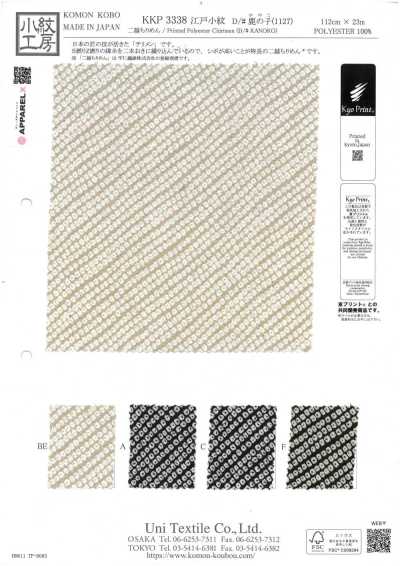
Edo komon is a small-pattern design that originated in Edo, created by repeatedly stencil-dyeing an extremely fine motif across the entire surface so that, from a distance, it can also appear solid.

Contents6 sections
Definition and Overview
Edo komon is a dyed pattern created by repeating a finely detailed identical motif across the entire fabric. It is best known as a dyeing technique for kimono; from a distance it appears calm and solid, while up close the intricate pattern stands out. Its defining feature is the neat, understated impression created by the fineness of the motif.
It is not a name for the weave structure or fiber type of the fabric, but for the pattern and the dyeing expression. It is used not only for silk kimono length fabric, but also for apparel fabrics such as cotton and polyester, where it may be developed as a small-pattern allover design.
Pattern Origins and Main Types
Edo komon is said to have developed from the fine family crests used on samurai formal garments. In stencil dyeing that uses paper stencils, it is important to maintain the outline of the motif accurately while dyeing a fine pattern in continuous repetition.
Representative patterns include same komon, which links fish scales with tiny arcs; kadotōshi, which repeats extremely small checks; and gyōgi, which arranges dots in an orderly manner. These are representative Edo komon patterns, but they are not synonyms for Edo komon as a whole.
- Same komon: a fine scale-like motif made by overlapping semicircles.
- Kadotōshi: a grid-like motif made by arranging small squares in a regular pattern.
- Gyōgi: a motif that places small dots in an orderly diagonal arrangement.
Main Uses and Seasons
Traditionally, it is used for kimono, haori, and obi-related items. In modern apparel, when used for blouses, shirts, dresses, skirts, and jacket linings or panel inserts, it becomes a solid-looking design with visual interest when seen up close.
Edo komon is a pattern name, and it does not determine the season on its own. The wearing season is judged by the material, thickness, sheerness, color, and construction. A thin, breathable fabric can be designed for spring and summer, while a fabric with density and fabric weight can also be used for autumn and winter.
Fabric Selection and Cutting Notes
When selecting fabric, check whether the fineness of the pattern remains visible without being lost due to the surface texture or finishing of the material. On fabrics with strong sheen or texture, the motif may become hard to see, and on coarse weaves the outline of a delicate pattern may become unclear.
Even though Edo komon is an allover pattern, some designs may have a top-and-bottom direction or one-way orientation. Before cutting, check the selvedge, the direction of the pattern, and the size of one repeat, and align how it appears on the left and right body pieces, collar, pockets, and panel positions. Even with a fine pattern, grainline shifts may be noticeable.
When matching the pattern, allow extra yardage based on the repeat and the effective fabric width. In particular, for designs with large panels, front openings, or pockets, it is important to confirm the continuity of the pattern at the seams with a sample.
Differences from Similar Terms
Komon is a broad term that generally refers to a pattern repeated across the entire fabric, or to a kimono with such a pattern. Edo komon is a type of komon distinguished by its highly refined repetition of microscopic motifs and its solid-like appearance.
Dots, pinhead, and geometric patterns also include fine repeated designs, but Edo komon is a term rooted in the tradition of stencil dyeing and its aesthetic sensibility. In product planning, confirm not only the look of the pattern, but also the motif name, dyeing method, and material specifications separately.
Frequently Asked Questions
Are same komon and Edo komon the same meaning?
Same komon is one of the representative patterns of Edo komon. Edo komon also includes several other types, such as kadotōshi and gyōgi. Therefore, it is appropriate to distinguish same komon as a specific motif name rather than treating it as another name for Edo komon as a whole.
Does Edo komon fabric require pattern matching?
If the pattern unit is extremely fine and appears solid from a distance, precise pattern matching may not be required as it would be for a large pattern. However, where the design has a top-and-bottom direction, or at the collar, front opening, and pockets, misalignment may stand out. Check the direction and repeat of the pattern before cutting.
Is Edo komon only a summer pattern?
Edo komon itself is not a season-specific pattern. Whether it is used for spring and summer or autumn and winter depends on the type of material, thickness, sheerness, color, and construction. Thin materials can be used for shirts and blouses, while firmer fabrics can be used for dresses and outer layers.