Eyelet Lace
Eyelet lace is an openwork embroidered lace in which holes are made in the fabric and the surrounding edges are bound with embroidery yarn to reinforce them while creating floral patterns and other designs.
Contents6 sections
Definition and Overview
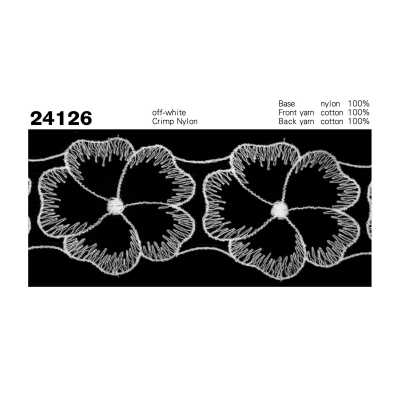
Eyelet lace is a lace with holes made in the base fabric, and the edges of the holes are densely embroidered to create patterns. The round holes, or eyelets, are often given the appearance of flower centers or leaf veins, combining embroidered dimensionality with sheerness.
Broderie anglaise often refers to embroidery worked in white thread on white cotton fabric, and is sometimes treated as nearly synonymous with eyelet lace. However, the term varies depending on the material, pattern, and distribution field.
Construction and Materials
In general, a woven fabric such as plain weave is used as the base fabric, and after the pattern is created with embroidery, the hole sections are cut out, or openings are formed together with the embroidery process. The area around the holes is reinforced with buttonhole-style embroidery and similar stitching.
Cotton is commonly used, and its light, cool appearance is a defining feature. Depending on the design, base fabrics and embroidery yarns including polyester may also be used. The material, base-fabric density, and amount of embroidery affect stiffness, sheerness, and ease of handling.
Visual Features and Uses
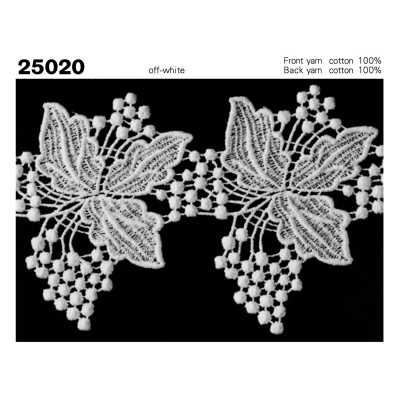
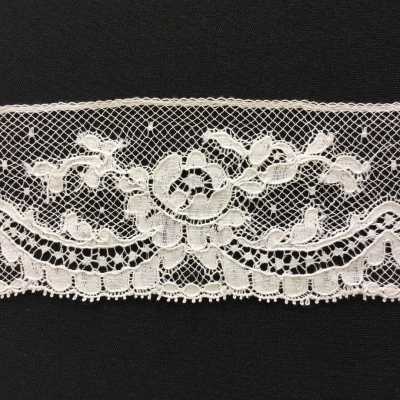
Its characteristics are the openwork pattern created by the holes and the raised embroidery around them. It ranges from delicate designs with small continuous holes to large floral patterns and designs with scallops at the hem, making it a fabric that easily creates a simple, clean impression.
It is used for blouses, shirts, dresses, skirts, children's clothing, and nightwear. For patterns that are especially sheer, lining is added, or it is used in partial applications such as yokes and sleeves to make use of the sheerness as part of the design.
- When used over the entire garment, the appearance of the hole pattern changes depending on the color of the fabric layered underneath.
- When using a scalloped edge at the hem or cuffs, the pattern placement should be considered during cutting.
- Check the direction and repeat of the embroidery pattern, and match the appearance on both sides.
Selection and Sewing Notes
When selecting the fabric, check the base-fabric thickness, hole size, amount of embroidery yarn, pattern direction, and sheerness. If large holes or raised embroidery overlap the seam allowance, sewing becomes difficult and the seams may become unstable, so pattern placement should be considered on the pattern.
Eyelet lace itself is usually not a stretch material. However, thin base fabrics can stretch or distort depending on the grain direction and how they feed during sewing, so if necessary, shape should be supported with stay tape or facings.
Cut edges may fray easily depending on the structure of the base fabric and the embroidery placement. It is important to secure enough seam allowance and choose an edge finish that suits the design and fabric, such as overlocking, French seams, or bias finishing.
Washing and Handling Notes
Washing methods vary depending on the fiber blend ratio, dyeing, embroidery yarn, and whether trims are attached, so follow the care label on the product. The holes and embroidered areas can snag easily on other garments or hardware, so using a laundry net and avoiding strong friction helps reduce damage.
After washing, reshape the holes and scalloped edges before drying. When pressing, it is best to use a pressing cloth from the reverse side to avoid flattening the embroidery or causing fading. It is reassuring to test wash a fabric sample in advance.
Frequently Asked Questions
What is the difference between eyelet lace and cutwork?
Cutwork refers to an embroidery technique or the fabric made by cutting away parts of the cloth to create an openwork pattern. Eyelet lace is a term centered on the expression of reinforcing the edges of holes with embroidery. In practice, the two terms may sometimes be used with overlapping meanings.
Does eyelet lace stretch?
Ordinary woven eyelet lace does not have elasticity like knit fabrics or polyurethane-blend materials. However, thin base fabrics and bias directions are prone to stretching, and behavior also changes depending on the spacing of the embroidery pattern. Check the grain and stretch before sewing.
How do you prevent fraying in eyelet lace?
The hole edges are reinforced with embroidery, but the cut edges may still fray. It is important to secure enough seam allowance, use overlocking or French seams, and avoid leaving an unnecessarily narrow seam allowance near the holes. Also check seam stability in a prototype.