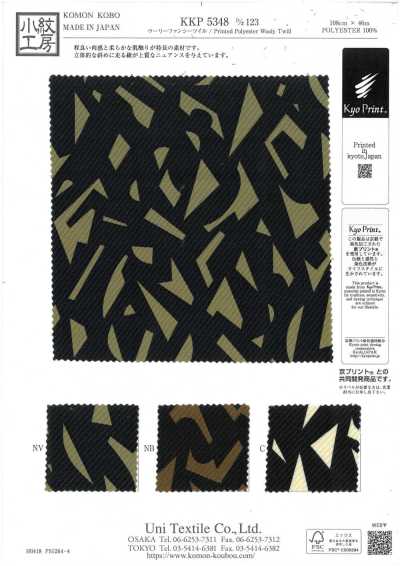
Fancy Twill Weave
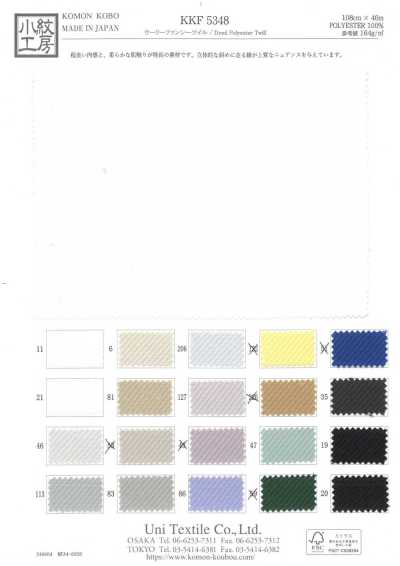
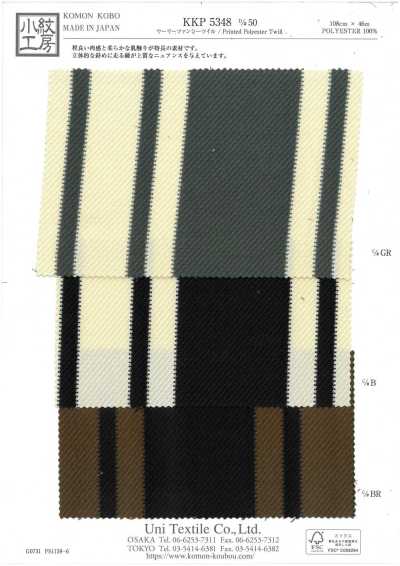
Fancy twill weave is a twill fabric characterized by twill lines that appear at a sharp angle. It is also called tricotine or kersey, and is mainly used for garment fabrics, linings, and pocket lining.
![59439-22 26AW BEST SELECTION [FANCY WORSTED] Dark Navy Check Weave Pattern](/img/item/thumb/YX/1103779_t2.jpg)
Contents6 sections
Definition and Overview
Fancy twill weave is a type of twill in which diagonal ribs appear continuously at a relatively steep angle. It is also called tricotine, and in distribution it may also be handled under the name kersey. It does not refer to a fiber type, but mainly to the weave structure and the appearance of the surface.
Because the warp and weft are woven by floating them in a fixed pattern, diagonal lines appear on the surface. Thickness and firmness vary greatly depending on yarn thickness, density, blend ratio, and finishing, ranging from lightweight lining textiles to firm outer textiles.
Features
The steep twill line creates a neat diagonal appearance and a moderate sense of dimension. Compared with plain weave, the structure is more visible, and depending on the yarn and finishing design, it can have smoothness, resilience, body, and drape.
Strength, stretch, moisture absorbency, luster, and wrinkling cannot be determined by the name fancy twill weave alone. For example, products blended with polyurethane are more likely to have stretch, while products made only from natural fibers may require attention to shrinkage and wrinkling after washing.
Main Applications
It is used for garment fabrics such as jackets, pants, skirts, and dresses. Those designed with a high density and a smooth surface are also used for linings such as body linings and sleeve linings. It may also be used as pocket lining for pocket bags and waist linings.
The suitable season depends on the material composition and fabric weight. Thin fabrics with fine yarns are considered for spring and summer linings and light apparel, while thicker fabrics with warmth are considered for fall and winter bottoms, jackets, uniforms, and similar items.
Selection and Handling Notes
When selecting, check not only the twill angle but also the blend ratio, fabric weight, density, stretch, surface-to-back slipperiness, and care label. For outer fabrics, identify the needed performance according to the application, such as silhouette retention and resistance to wear, and for linings, slipperiness and the level of static electricity.
When cutting, the twill line and grainline appear diagonal, so aligning the direction of the twill line on the left and right pieces makes it easier to achieve a neat appearance. Because the diagonal direction may stretch easily, consider using interfacing or stay tape on areas where stretch should be controlled, such as pocket openings, front edges, and the waist.
Shrinkage, color fading, wrinkling, and changes in luster due to washing depend on the material and processing. Before mass production, do not judge from the fabric swatch alone; it is important to carry out washing tests and ironing tests after sewing, and confirm whether fabric relaxation or hot-water shrinking is necessary, as well as the pressing conditions.
Differences from Similar Terms
Twill is the general term for twill weaves, while fancy twill weave is the name for a twill fabric characterized by a steep twill line. Gabardine, on the other hand, generally refers to a fabric with a high density and a steep twill line, but because established material, specification, and application conventions apply, it is not always exactly synonymous with fancy twill weave.
Kersey is sometimes used in Japanese textile distribution with a meaning close to fancy twill weave. However, the name alone cannot uniformly determine the structure, density, or blend ratio. When placing orders or confirming specifications, check the weave diagram, front and back, twill direction, and quality sample together.
Frequently Asked Questions
What is the difference between fancy twill weave and twill?
Twill is the broad term for all twill weaves with diagonal ribs. Fancy twill weave is the term for those characterized by a steep-looking twill line. However, the actual twill line, thickness, and texture vary depending on the yarn used and density, so check with a fabric sample.
Can fancy twill weave be washed at home?
Whether washing is possible is determined not by the fancy twill structure, but by the blend ratio, dyeing, finishing, and sewing specifications. In particular, products containing natural fibers may shrink or wrinkle, so always follow the care label on the fabric or product and conduct a preliminary test.
Are there any precautions when cutting fancy twill weave?
In fabrics with a noticeable twill line, uneven diagonal direction between the left and right body panels or pockets can create a visible difference in appearance. Make sure the grainline is correct and check the direction of the twill line before cutting. If the diagonal direction stretches significantly, also consider anti-stretch reinforcement.
![M02108-2 KUNISHIMA1850 Exclusive Line [Hachisu Wool] Dark Navy/Small Pattern](/img/item/thumb/YX/1109514_t2.jpg)