


Hakata-ori
Hakata-ori is a textile that developed in the weaving production area centered on Hakata in Fukuoka City, Fukuoka Prefecture, and is represented by obi fabric woven with many warp yarns and tightly beaten weft yarns.
Contents6 sections
Definition and Production Area
Hakata-ori is a textile that has been passed down mainly in the Hakata area of Fukuoka City, Fukuoka Prefecture. It does not refer to a specific fiber name or a single weave structure; rather, it is used as a term that includes the characteristics of the production area as well as weaving techniques and designs represented by obi fabric.
It is best known as a Japanese kimono obi fabric, but today it is also used for apparel fabrics, bags, accessories, and interior decor. When sourcing fabric, it is important not to judge the material, weave structure, or application from the name Hakata-ori alone.
Weaving Characteristics and Texture
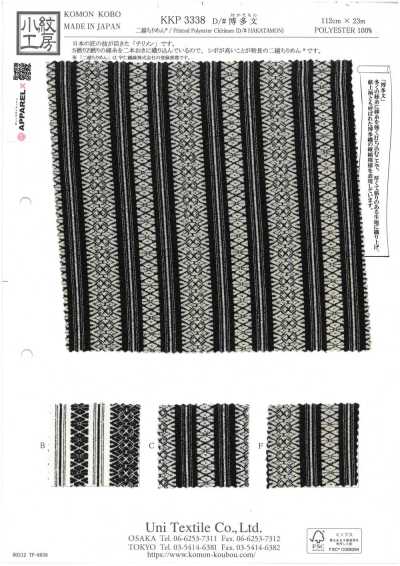
Representative Hakata-ori is woven with many warp yarns and firmly beaten weft yarns. As a result, it generally has thickness, firmness, and a dense appearance, and it tends to hold its shape well when tied as an obi.
Many designs feature stripes and geometric patterns expressed in the warp direction, and the design known as the Kenson pattern is also a representative example. However, stiffness, luster, and thickness vary greatly depending on the pattern, yarn use, density, and finishing.
- Dense construction using many warp yarns
- Firm texture created by beaten-in weft yarns
- Designs that make use of stripe patterns and geometric motifs
- Development centered on obi fabric using silk
Representative Fabrics and Applications
In Hakata-ori, obi fabric is the main application. Among these, the Kenson pattern is widely known as a design that combines distinctive stripes and motifs. Depending on the application, there are glossy types, firm ground types, and relatively light types.
In apparel and fashion accessories, it is used for partial accents, vests, jackets, bags, belts, and small items, making use of its firmness and three-dimensional patterns. When using it for garments, the fabric width and thickness may not match the specifications for obi fabric, so be sure to check whether the design is suitable for the intended application.
Points to Check When Sourcing
For projects that emphasize the production area, confirm with the supplier whether the fabric was woven in Hakata or whether it is a fabric that applies Hakata-ori designs and texture. When handling the production area name in labeling or promotional materials, the weaving location and labeling conditions that support it also need to be confirmed.
For fabrics with complex weave structures and many color and pattern options, stock status, minimum order quantity, whether additional production is possible, and delivery time may vary depending on color and pattern. Before full production, check the roll width, pattern direction, pattern repeat, selvedge condition, and cutting loss.
- Basis for the production area description and weaving location
- Material, blend ratio, weave structure, thickness, and texture
- Fabric width and usable width, pattern direction, pattern repeat
- Stock availability, minimum order quantity, and lead time for additional production
- How color differences and lot differences are managed
Differences from Similar Terms
Hakata obi usually refers to an obi made from Hakata-ori, or Hakata-ori intended for obi use. Hakata-ori, on the other hand, can refer to the broader range of textiles developed in the production area, not only obi. Therefore, Hakata obi and Hakata-ori are not always completely synonymous.
Nishijin-ori is also a production area name known for traditional kimono textiles, but it differs from Hakata-ori in both its production area and its representative weaving characteristics. Jacquard, meanwhile, is a term related to the technique and loom used to weave patterns, not a production area name like Hakata-ori.
Frequently Asked Questions
Is all Hakata-ori silk?
Hakata-ori is not a material name, so it is not necessarily all silk. Silk is the representative material for traditional obi fabric, but other fibers may also be used depending on the application. When sourcing, be sure to check the blend ratio and yarn type separately from the Hakata-ori name.
What should I watch out for when using Hakata-ori in garments?
Hakata-ori designed as obi fabric may have firmness and thickness, and the fabric width may be limited. For garments, review ease in moving parts, seam allowance thickness, yarn pulling caused by sewing needles, and pattern direction in advance, and verify sewing performance and wearing comfort through prototyping.
What is the difference between Hakata-ori and Hakata obi?
Hakata-ori is a general term for textiles developed mainly in the Hakata area, and includes products and fabrics other than obi. Hakata obi is a term that usually refers to an obi made from Hakata-ori, or to obi fabric. When placing an order, specifying whether it is obi fabric or apparel fabric can help prevent misunderstandings.





