Milanese Buttonhole
A Milanese buttonhole is a buttonhole specification that combines a hole on the front side with a leg-shaped passage on the back side, creating a thread shank for sewing on.
Contents6 sections
Definition and Overview
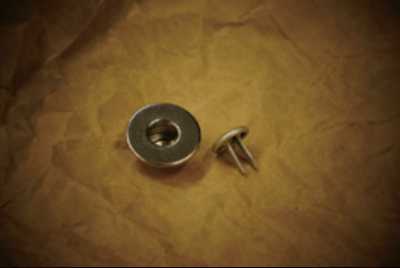
A Milanese buttonhole refers to the hole specification made on the button itself. It has a visible hole on the front side and a leg-shaped passage for thread on the back side, creating suitable space between the button and the fabric for attachment.
It includes the same term as the “buttonhole” made on the garment side, but a Milanese buttonhole is the shape of the hole on the button side. It is distinguished from blind buttonholes, eyelet buttonholes, and hand-worked buttonholes made on plackets and similar areas.
Structure and Materials
Thread passed through the front hole goes through the leg-shaped passage on the back side. This structure makes it easier to create a thread shank with sewing thread, and helps the button sit stably even when used on thick fabric.
Materials vary, including polyester resin, urea resin, natural materials, and metal, so the hole specification alone does not identify the material. Heat resistance, solvent resistance, impact resistance, and color change over time differ by material.
Size Notation and Applications
The size of a button is generally expressed by its outer diameter in lignes or mm. Lignes are a traditional unit used for buttons, and in orders and specifications, thickness, hole size, color, and material are also checked in addition to the outer diameter.
It is used for front openings with thick fabric or layered facings, such as jackets, coats, and uniforms. The button thickness and the height of the back shank are selected according to the fabric thickness, the buttonhole thickness, and the frequency of fastening and unfastening.
- In specifications, clearly state the outer diameter in lignes or mm.
- Set the buttonhole length by considering not only the button’s outer diameter but also its thickness.
- At the sample stage, check ease of fastening and unfastening, as well as button tilt.
Attachment Method and Handling Notes
When sewing on, pass the thread through the front hole and the back passage, leaving the necessary slack between the button and the fabric. On thick materials, if the thread shank is too short, fastening becomes difficult, and if it is too long, the button tends to tilt, so check with the actual fabric thickness.
Suitability for washing, dry cleaning, and ironing depends on the button material and finish, not on the hole structure. Contact with high heat from an iron, strong impact, and contact with other components during washing may cause cracking, chipping, coating peel-off, or discoloration.
- Check the care label together with the handling conditions for the button material and finish.
- Do not apply the iron directly to the button; use a pressing cloth if necessary.
- Whether dry cleaning is allowed should be confirmed in the trim specifications, including the solvent to be used.
Differences from Similar Terms
Shank buttons refer to buttons in general that have a separate shank on the back side. A Milanese buttonhole is a hole specification that creates a thread shank through the hole and back passage, and its structure differs from an independent metal or resin shank such as a ring shank or parachute shank.
Two-hole buttons and four-hole buttons are terms mainly classified by the number of holes visible from the front. Milanese buttonhole is treated as a term that focuses not only on the front hole but also on the back-side passage structure.
Frequently Asked Questions
Are Milanese buttonholes the same as garment buttonholes?
No, they are not the same. A Milanese buttonhole refers to the hole and back-side passage structure provided on the button. By contrast, a garment buttonhole is the opening made in fabric so the button can pass through and fasten. In specifications, it is smoother to list them separately.
Can Milanese buttonholes be used on thick materials?
Yes, but the button thickness, the height of the back shank portion, and the length of the thread shank during sewing need to be matched to the fabric thickness. Check the fastening and unfastening performance and button stability using a test piece with the actual outer fabric, interlining, and facing layered together.
Are there any precautions for washing or ironing?
Precautions depend more on the material and finish than on the hole shape of the button. Resin buttons that are weak against heat, or buttons with coating or plating, may deform or discolor under direct ironing, high-temperature drying, or strong friction. Check the product labeling and trim specifications.