Top Coating
Top coating is a finishing specification that applies paint to the top surface of visible metal components such as press fasteners and eyelets, adding color and decorative appeal.
Contents6 sections
Definition and Overview
Top coating is a finishing process that adds color by painting the visible surface area on the top side, called the “top,” of hooks and eyelets. Unlike the color of the metal itself or plating, it gives the appearance a finished look through the surface coating. Depending on gloss and color tone, it makes it easier to coordinate the accessory with the textile or product color scheme.
Top coating is not a name that indicates the type of part, but a term that indicates a surface finish. For that reason, even with the same top coating, it is necessary to check the specifications according to the part and part configuration involved, such as press fasteners, eyelets, and washers.
Materials and Part Configuration
In many cases, the target of top coating is a metal front-side part. For eyelets, the eyelet body and washer are used together, and the top surface of the eyelet visible on the front side may be painted. Since there are also specifications that allow the eyelet and washer colors to be set separately, both colors should be checked separately when ordering.
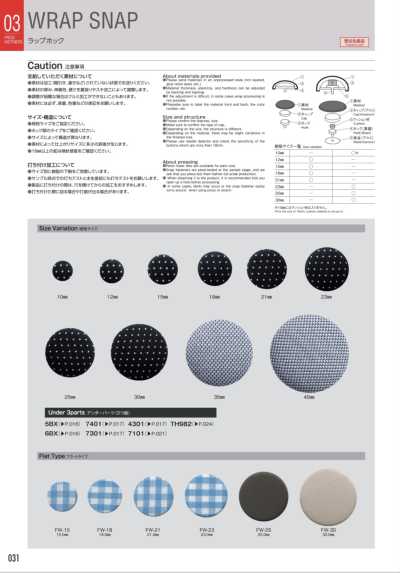
Press fasteners combine multiple parts such as the cap, stud, spring, and eyelet. Top coating is mainly used on visible parts such as the cap, but the mating part, metal type, and whether plating or coating is applied should be clearly stated in the specification sheet.
- Eyelet products: check the combination of the eyelet body and washer.
- Press fastener products: match the front-side part and the opening/closing mechanism parts.
- Color specification: specify the top-coated part and washer colors separately.
Size Indication and Attachment
Sizes differ depending on the type of part. For eyelets, items to check include the hole diameter, outer diameter, and leg length; for press fasteners, the cap diameter and part standard are among the confirmation items. The name top coating alone does not determine dimensions or compatibility of combinations, so the dimensional notation for each part must be checked.
Attachment is done by using tools that match the part and crimping it with a hand press or a foot-operated press machine. If the tool does not match, coating damage, part deformation, insufficient crimping, or over-crimping can occur, so trial pressing should be performed before mass production using the actual textile and interfacing.
Main Applications
Top coating is used for accessories where a metallic look should be reduced, or for closures and reinforcement areas that should blend with the fabric color. It is chosen for outerwear, shirts, workwear, bags, and similar items to match the appearance of press fasteners and eyelets to the product design.
On the other hand, in areas subject to strong friction, areas that open and close frequently, or areas likely to contact hard metal parts, wear on the coating may become noticeable. Consider usage frequency, whether the product will be washed, and contact during storage when deciding whether to adopt it.
Selection and Precautions
If the leg length or compatible fabric thickness does not match the fabric thickness, density, and stretch, it may cause the part to rotate, come off, or damage the textile. For thin fabrics or stretch materials, reinforce the surrounding area with interfacing or a pressing cloth as needed, and also check the tensile strength in the cross direction.
If the coating is scratched, the base metal may be exposed, and discoloration or rust may occur due to humidity, sweat, or washing conditions. Wash resistance and abrasion resistance vary depending on the finish and usage conditions, so evaluate them through testing that reflects the product conditions. Nickel-free and needle detector compatible cannot be determined only from the fact that it is top coated; part-by-part specification confirmation is required.
- Before mass production, check the tool, pressing pressure, and crimping condition with the actual textile.
- Include color specifications in the specification sheet, including the coating color and washer color.
- Check whether needle detector compatibility is possible according to the sensitivity of the needle detector and the product inspection standards.
- If there are requirements related to nickel, confirm the material and surface treatment specifications.
Frequently Asked Questions
What is the difference between top coating and plating?
Top coating is a finish that adds color by forming a paint film on the surface of the part, while plating is a surface treatment that forms a metallic film. They may look similar, but the way they scratch, how they appear when worn, and their corrosion resistance differ depending on the base material and treatment conditions. When adopting it, check not only the appearance but also the usage environment.
Do top-coated eyelets have washers in the same color?
They are not necessarily the same color. With top-coated eyelets, the color of the eyelet body and the color of the washer may be set separately. For products that need the visible colors on the front and back sides to match, it is important to specify the eyelet color and washer color separately and check the appearance with a prototype.
Can top-coated press fasteners be washed?
Suitability for washing varies depending on the type of coating, base metal, pretreatment, washing method, and contact with other parts. Wash durability cannot be determined from the top coating specification alone. If product washing, strong friction, or the use of bleach is expected, check for coating peeling and discoloration through testing that is close to the actual product conditions.