


Panel Print
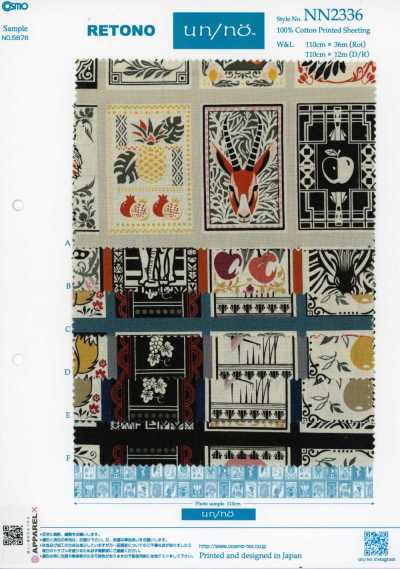
A panel print is a pattern designed to place a single-image motif or a continuous composition within each fixed section of the fabric, with intended positioning for use on each garment part.
Contents6 sections
Definition and Overview
A panel print is a pattern that is constructed in units divided by a fixed length or width, rather than repeating the same small motif across the entire fabric. Some designs feature large-scale depictions of flowers, people, plants and animals, landscapes, or text.
It is often expressed through printing, but panel print refers to the placement of the pattern, not the processing method. It is not a name that limits the weave, knitting structure, or type of material.
Pattern Structure and Types
Some designs complete the image within a single panel, while others form a larger picture when the upper and lower or left and right panels are joined. There are also designs that combine border-like patterns for the hem. In some cases, the panel dividing lines are not clearly defined.
The term used may vary depending on the planning or sales channel. Panel print often refers to a panel pattern made by printing, while panel fabric may broadly refer to fabric with a panel pattern.
- Single-image type: The motif or composition is completed within one section.
- Connected type: Multiple sections are used in sequence to create a larger composition.
- Placement type: The pattern is placed with the garment's focal areas in mind, such as the neckline, front body, or hem.
- Border-combined type: A band-like decorative pattern is arranged at the edge of the panel.
Main Applications and Seasonality
It is used for dresses, skirts, blouses, tunics, cut-and-sew items, scarves, and more. Because large motifs can be placed on the front body or hem, it is well suited to planning centered on the pattern itself as the main design element.
In thin printed fabrics, it is often used for spring and summer products, but panel print itself is not seasonal. Depending on the material, thickness, sheerness, and finishing treatment of the fabric, it is also used for autumn and winter items and fashion accessories.
Fabric Selection and Cutting Notes
When selecting, check the fabric width, dimensions of one panel unit, the vertical direction of the pattern, and the pattern position from the selvedge. It is important to determine the required pattern placement on the pattern pieces in advance and consider whether each part, such as the body or sleeves, fits within one unit.
Compared with a standard all-over print, it may require extra yardage because the pattern must be cut to match the design. When grading sizes, also check whether the motif position shifts from size to size and whether the appearance on the left and right body panels or sleeves looks unnatural.
Before cutting, confirm whether there are any differences in panel length or pattern position partway through the roll, and align the top and bottom directions when spreading the fabric. If an important motif falls within the seam allowance, or if the image is interrupted at a seam, the pattern layout must be adjusted.
- Clearly identify the top and bottom of the pattern and the right and wrong sides of the fabric before cutting.
- Align the reference positions of the pattern for the front and back bodies, left and right sleeves, and other parts.
- Confirm the required number of cut pieces for each pattern unit.
- Indicate the reference motif position and cutting direction in the specification sheet.
Differences from Similar Terms
An all-over print is a pattern in which the same or similar motif is repeated across the entire fabric. In contrast, panel print is characterized by giving each section its own composition and considering its placement on the garment.
A border generally refers to a band-like pattern that continues in the fabric width direction. Panel print may also include border-like parts, but the term panel print covers not only bands, but also single-image compositions and the structure of the entire section.
Frequently Asked Questions
Does panel print require more fabric than a normal all-over print?
In many cases, yes. This is because the parts are placed to match the desired motif position, and cutting may cross one pattern unit. Confirm the required amount using a marker that reflects the fabric width, panel dimensions, size range, and left-right pattern matching.
Can panel print be cut upside down?
If the design has directionality, such as flowers, people, or text, cutting it upside down will create an unintended appearance. Before cutting, check the top and bottom and the right and wrong sides of the pattern, and standardize the spreading direction, marker placement, and cutting instructions. Even if the directionality is unclear, it is important to confirm with a sample.
What is the difference between panel print and border?
A border refers to a continuous band-like pattern, whereas panel print is a pattern composed within a fixed section. Since some panel prints include hem band patterns, share the pattern unit and the placement on the product with diagrams when planning or placing orders.





