Suede Tape
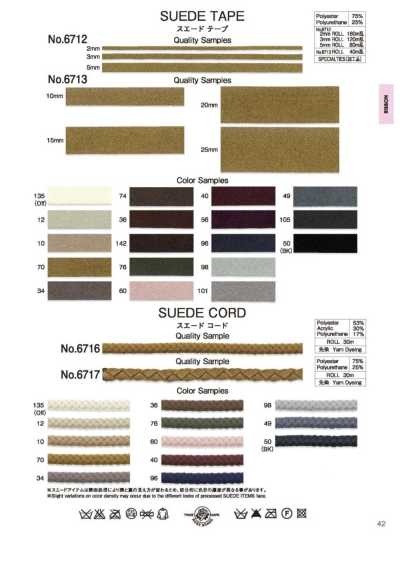
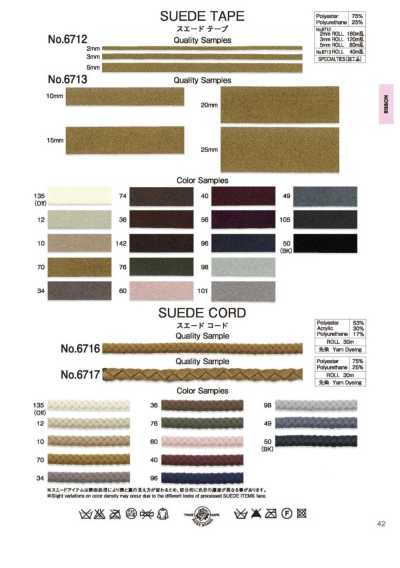
Suede tape is a narrow tape or cord with a brushed, suede-like surface texture, used as an auxiliary material for decorating apparel and fashion accessories, or as a cord.

Contents6 sections
Definition and Overview
Suede tape is a narrow-width material that expresses a soft, matte texture similar to natural leather suede. In apparel, it is used for decorative cords, ties, loops, and similar details, creating a casual or craft-like impression while adding texture.
Although it is called a tape, the term may also refer to cord-like products, not just flat shapes. Because it may be handled as suede cord in catalogs, it is important to confirm the cross-sectional shape when placing an order.
Materials and Structure
In many cases, polyester and similar materials are used, with the surface brushed to create a suede-like feel. Rather than being natural leather suede itself, it is generally distributed as faux suede made from synthetic materials.
It is not a material whose properties can be judged only by the type of weave, knit, or braid. Depending on the structure, such as flat tape, round cord, or cord with a core, the thickness, firmness, stretch, and cut edge condition differ.
- For flat types, confirm the specification by width and thickness.
- For round types, confirm the diameter by thickness.
- For products that can be piece dyed, confirm the desired color and the texture and dimensional change after dyeing in advance.
Main Applications
Main applications include accessories such as necklaces and bracelets, bag cords and decoration, design details around shoes, and lacing, ties, and loops for apparel. Flat types may also be sewn onto the neckline, front opening, or pocket opening as an accent.
For applications that are subjected to sustained heavy load, check not only the appearance but also tensile strength, reinforcement at the sewn section, and resistance to abrasion. Decorative narrow materials have different required performance from structural components such as handles and safety parts.
How to Choose and Handling Precautions
When selecting, confirm the shape, width or thickness, thickness, color, appearance of the nap, and required length. If sewing it on, make a sample under the same conditions as mass production to check whether the nap is disturbed at the seam and whether needle holes are noticeable.
Depending on the material and processing, it may stretch under tension or shrink due to washing or heat. Also pay attention to fuzzing at the cut edge, fraying at the ends, changes in the nap due to friction, and color transfer. If the product will be washed, perform testing in advance.
- Use a sharp blade for cutting and check for fuzzing.
- If using an iron, start at low temperature and test on an inconspicuous area using a pressing cloth.
- For dark-colored products, check for color transfer caused by friction when wet.
Differences from Similar Terms
Suede tape is a term that refers to a suede-like surface texture. Flat cord refers to the shape of a flat cord, and round cord refers to the shape of a round cross section; suede-like flat cord and round cord may be handled as suede tape or suede cord.
Leather cord often refers to cord made by cutting natural leather or leather material into a narrow strip, and its raw material and handling method differ from suede tape. Piping refers to a specification in which a cord is wrapped in fabric to decorate and reinforce the edge of a seam.
Frequently Asked Questions
Can suede tape be washed?
Whether it can be washed depends on the material and processing. Even polyester products may experience changes in the brushed feel, shrinkage, color transfer, and waviness at sewn sections. If product washing is planned, carry out a washing test under the same fabric and sewing conditions and determine the care label accordingly.
What is the difference between suede tape and suede cord?
The distinction is not strictly fixed, but in general suede tape tends to refer to flat narrow material, while suede cord tends to refer to round or cord-like material. However, because the commercial names overlap, confirm the width, thickness, cross section, and whether it has a core in the specifications.