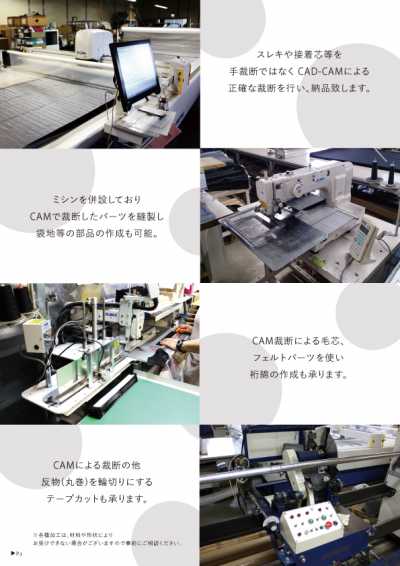
Automatic Thread Trimming
Automatic thread trimming is a device on industrial sewing machines and the like that mechanically cuts the upper and lower threads at the end of sewing to reduce thread finishing work.

Contents6 sections
Definition and Overview
Automatic thread trimming is a function or device that cuts the upper and lower threads on a sewing machine at a prescribed position, such as at the end of sewing. It is used to eliminate the step of the sewing operator cutting threads with scissors and to reduce production time on the sewing line and variation in thread ends.
It is generally installed on lockstitch sewing machines, but availability, the cutting mechanism, and operation method vary depending on the model and sewing method. In addition to simply cutting threads, it also plays the role of preparing the remaining thread length needed to start the next sewing operation.
Position in Product Manufacturing
Automatic thread trimming is used in sewing processes where cut parts are sewn together. Since thread finishing and inspection are performed after sewing to handle any remaining thread ends, automatic thread trimming does not completely eliminate the need for final thread finishing.
In mass production, its effect on work efficiency is especially large in processes with many backtacks or repeated short sewing operations. On the other hand, it may not be suitable for specifications that leave long decorative threads, areas that require hand-knotting, or designs that intentionally show thread ends as part of the appearance.
Practical Points for Introduction and Operation
In specifications and sewing instructions, make clear for each process not only whether automatic thread trimming is used, but also whether backstitching at the start and end of sewing is required, the thread end length, and whether thread may appear on the face side. Check the actual thread ends with a sample sew and share a standard sample before mass production.
Depending on fabric thickness, slipperiness, stretch, the type and thickness of sewing thread, and the combination of needle and thread tension, thread pulling after cutting or seam distortion may occur. Test sew under the same conditions as mass production, and adjust the thread trimming timing or sewing conditions if problems arise.
- Specify which processes use automatic thread trimming and which do not.
- Confirm the acceptable condition of thread ends separately for the face and reverse sides with standard samples.
- In trial sewing, also check laundering performance and seam opening during wear.
- Include machine cleaning, blade wear, and removal of lint in daily management.
Points to Note in Ordering and Quality Control
When placing an order with a sewing factory, do not rely only on whether it has machines equipped with automatic thread trimming; confirm whether it can operate stably for the target item, fabric, and sewing specifications. If you assume reduced process time, also determine the calculation conditions and thread finishing standards at inspection.
In quality checks, confirm leftover thread after cutting, thread breakage, unraveling at the end of sewing, thread protruding to the surface, and lint adhesion. In particular, on light-colored fabrics, thin fabrics, brushed materials, and knits, lint and thread ends tend to stand out, so it is important to define the appearance inspection criteria specifically.
Differences from Similar Terms
Automatic thread trimming refers to the cutting function or device on a sewing machine, while thread snips are a tool used by the sewer to cut threads by hand. Thread finishing refers to the overall work, including removing leftover thread ends, tying knots, and preventing unraveling, so it is used in a broader sense than automatic thread trimming.
Overlock is a sewing method that joins fabric edges while preventing fraying, and its purpose differs from automatic thread trimming. However, depending on the process, an overlock machine may also be equipped with a thread cutting function.
Frequently Asked Questions
If there is automatic thread trimming, is thread finishing unnecessary?
No. Automatic thread trimming is a function for cutting threads during sewing, and leftover thread ends, protruding thread ends, and unraveling are checked by inspection and, if necessary, manual work. It is important to define the acceptable condition of thread ends for each side and each part of the product.
What should be written in the specification sheet when using automatic thread trimming?
List the process in which it will be used, whether backstitching is required, the areas where thread ends need to be left, and the appearance standards for the front and back sides. Because the finish changes depending on compatibility with the fabric and thread, sharing a sample sewn under the same conditions as mass production as the standard with the factory helps prevent misunderstandings.