S Spring / Ring Spring
S spring and ring spring are metal spring components built into the female side of a press fastener, where they hold the male side by spring force so it can be opened and closed.
Contents7 sections
Definition and Overview
S springs and ring springs are spring components on the female side of a press fastener that receive the male side. When pressed to fasten, the male side spreads the spring open, and it is held by the spring’s restoring force. Both are components related to the opening and closing performance and holding force of press fasteners.
An S spring refers to a spring whose cross-section looks S-shaped, while a ring spring refers to a circular spring. Because the feel when pressed, engagement force, and durability tendencies differ depending on the shape, fasteners with the same appearance are not necessarily interchangeable.
Component Structure and Materials
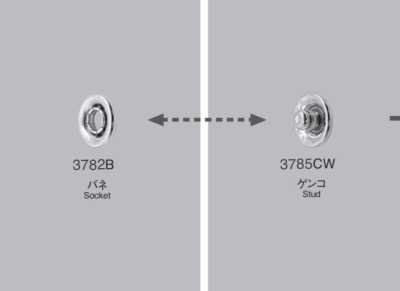
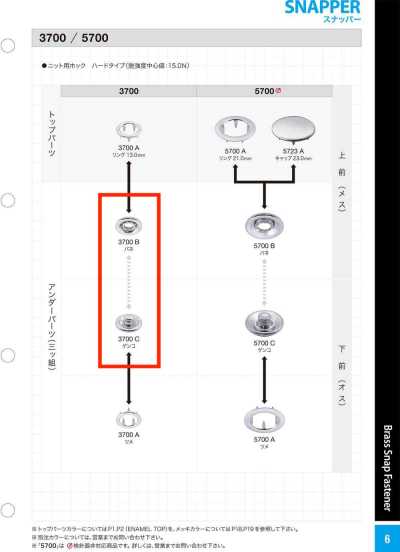
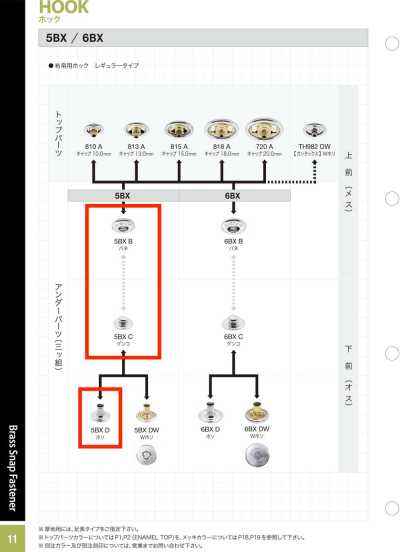
A typical press fastener is made by combining the front cap, the female-side socket and spring, the male side, and the back post or washer. The S spring and ring spring fit inside the socket and function as the part that directly engages with the male side.
They are often made of metal such as brass, and the surface may be plated or painted. It is important not to select the spring alone, but to specify the socket, male side, back post, and other parts as a set of the same standard.
- Cap: a decorative part visible on the front side.
- Socket and spring: form the female side and hold the male side.
- Male side: the part that is pressed into the female side to fasten.
- Back post or washer: the part that secures each component by sandwiching the fabric.
How Sizes Are Indicated
Sizes are generally indicated by the outer diameter of the cap or socket visible in the finished product, or by a set standard including the corresponding male side. Not only the spring shape, but also the outer diameter, inner diameter, part height, and back post length should be checked to specify the compatible combination.
Even with the same size name, dimensions, engagement, and recommended fabric thickness may differ depending on the component maker or series. For repairing ready-made items or additional production, it is safer to confirm the actual dimensions and perform a test setting.
Installation and Main Uses
Installation is done using a setting tool matched to the parts and a hand press, foot press, or air press. If the tool shape does not match, spring deformation, surface damage, or poor setting can occur, so use the specified tool for each part.
It is used for openings on coats, blousons, shirts, workwear, bags, and similar items. Depending on frequency of use, pulling direction, and the required ease of opening and closing, consider the press fastener specification, including whether to use an S spring or a ring spring.
- On fabric edges and plackets, use interfacing or reinforcement fabric as needed.
- Before mass production, confirm the setting conditions and engagement state on the actual fabric.
- After setting, inspect for surface and back-side damage, tilt, looseness, and opening/closing feel.
Points to Note When Selecting
On thin fabrics, if the back post is too long, the part may float; on thick fabrics, if it is too short, it may not be sufficiently clinched. Stretch fabrics, open-weave fabrics, and brushed fabrics are more prone to pullout and deformation, so check compatibility with fabric thickness, including reinforcement methods.
If the engagement force is too strong, the fabric may be stressed when opening; if it is too weak, it may come undone unintentionally. In addition to opening/closing tests, confirmation should be done assuming side force and repeated use.
Metal parts may rust, discolor, or develop verdigris due to sweat, humidity, washing, storage conditions, and similar factors. For products that require needle detection, check the specification for needle detector compatibility, and if nickel-related effects are a concern, confirm whether nickel-free is possible in the part specifications.
Differences from Similar Terms
Spring hook may refer to a type of press fastener that uses an S spring or ring spring on the female side. In contrast, S spring and ring spring mainly refer to the shape of the internal spring part. In practice, the two terms may be used interchangeably, so check the component structure.
A jumper hook is a press fastener with a structure different from a spring hook. Also, a sew-on snap is attached by sewing with thread, so its installation method differs from a press fastener with an S spring or ring spring, which is secured by setting tools.
Frequently Asked Questions
Can S springs and ring springs be swapped and used?
In principle, avoid replacing them individually. The socket, male side, and setting tool are designed to match the spring shape and series, and even if the outer diameters are close, the engagement force and fixing condition may not match. Select them as compatible set parts and confirm opening/closing and holding with a test setting.
What should be noted when attaching press fasteners to thin fabrics?
Thin fabrics can tear during setting, or the parts can come out during use, so match the back post length to the fabric thickness. If necessary, reinforce the attachment area with interfacing or pressing cloth, and confirm surface dents, protrusion on the back side, and pullout strength on the actual fabric.
Does nickel-free prevent discoloration and rust?
Nickel-free mainly refers to a specification regarding nickel use, and does not mean that all discoloration or corrosion will be prevented. The condition changes depending on the material, surface treatment, sweat and humidity, washing conditions, and contact with other metals. Check corrosion resistance according to the product application.