Sayagata
Sayagata is a geometric repeating pattern made by joining manji shapes continuously in a diagonal direction, and it is used as an auspicious motif symbolizing longevity and prosperity.

Contents6 sections
Definition and Overview
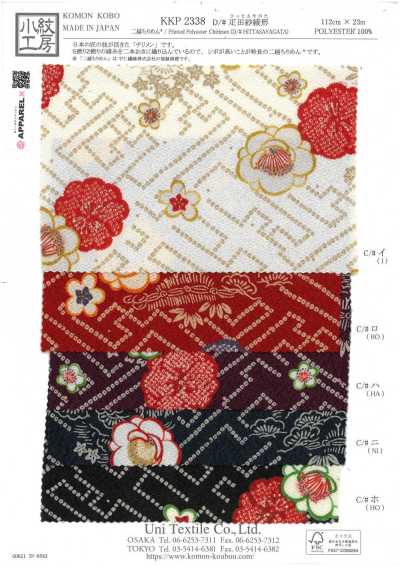
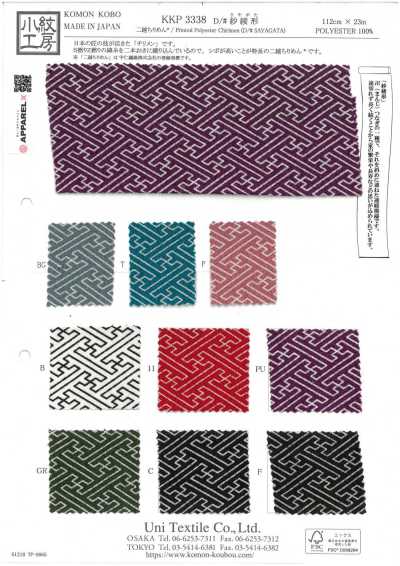
Sayagata is a Japanese geometric pattern made by connecting manji shapes in a broken-line form and repeating them diagonally. Because it appears to continue endlessly, it has been used as an auspicious motif symbolizing family prosperity and longevity, on kimono fabrics and ceremonial fabrics.
The name sayagata is said to derive from silk textiles introduced from China. However, sayagata is not the name of a weave structure or material, but the name of a pattern expressed through woven designs, prints, or jacquard-like ground patterns.
How the Pattern is Formed and Named
Sayagata is often explained as a type of manji continuous pattern, and its impression changes depending on line thickness, the angle of the turns, and the scale of the repetition. Small patterns look delicate and understated, while larger patterns make the outline of the motif clearer and increase the decorative effect.
In fabric, it may appear as an all-over ground pattern that emerges with the play of light, a print that makes the pattern clearly visible in multiple colors, or a woven pattern expressed by differences in weave structure. Sayagata motif pattern and sayagata pattern are also names used to refer to the same design.
Main Uses and Seasons
In traditional Japanese clothing, it is seen on kimono, obi, half collars, and fukusa, and in Western clothing, it is also used for linings and decorative fabrics in dresses, blouses, skirts, and jackets. It may also be incorporated into accessories, bags, and interior fabrics.
The pattern itself is not seasonal. Seasonal use is adjusted mainly by the material, color, and fabric weight, such as using a lightweight sheer material for spring and summer, or chirimen and heavier woven fabrics for autumn and winter.
Notes on Fabric Selection and Cutting
Because sayagata is a continuous pattern, check the top-to-bottom and left-to-right orientation of the motif before cutting. With a diagonally flowing appearance, if the direction is not aligned across the front panels, sleeves, and left and right body panels, the finished item may feel awkward.
For large patterns or patterns with a clear outline, position the pattern after deciding the motif placement at the center line, front edge, pocket, collar, and similar areas. When matching the pattern, allow extra yardage beyond the usual amount, and check the motif placement and repeat within the bolt in advance.
For fabrics where the front and back or the difference in sheen is hard to distinguish, such as ground patterns, mark the right side consistently during cutting. It is also important to align the grain and cutting direction so that the shine does not differ by section after sewing.
- Check whether the motif can be reversed top to bottom and left to right.
- Consider a layout that does not break the motif at the center front or center back.
- For facings and pockets, check the continuity and placement of the motif.
- Allow extra yardage as needed for pattern matching.
Differences from Similar Terms
Sayagata is a specific motif made by continuously repeating manji shapes. Ichimatsu pattern is a design made by alternating squares, and shippo tsunagi is a pattern made by linking circles, so their components and appearance are different. All are repeated Japanese patterns, but the names are used differently.
Also, Jacquard and dobby are terms mainly related to the method or structure used to weave patterns, and do not refer to sayagata itself. Sayagata can be expressed through Jacquard weaving, dobby weaving, printing, and other methods.
FAQ
Is sayagata the same as a manji pattern?
Sayagata is a motif formed by repeating manji shapes and is distinguished from a single manji shape. In product planning and specifications, rather than simply calling it a manji pattern, sharing that it is sayagata, along with the motif size, direction, and method of expression, helps prevent misunderstandings.
Does sayagata fabric require pattern matching?
Pattern matching is done when the pattern is large and the outline is clear, or when you want continuity at the center front, side seams, pockets, and similar areas. With fine ground patterns, it may be less noticeable, but it is still necessary to check the repeat and how the product will look before cutting.
Is sayagata the name of a weaving method?