Steam Finishing
Steam finishing is a process that applies steam to textile and uses moist heat treatment to relieve tension remaining after weaving and finishing, improving hand feel and dimensional stability.
Contents6 sections
Definition and Overview
Steam finishing is a finishing process that uses the heat and moisture of steam to smooth textile. It is performed to relax the tension in yarn and textile created during weaving, dyeing, and finishing, calm the hand feel, and reduce dimensional change in later processes.
Processing conditions and the processes before and after it vary depending on the material, textile structure, and desired hand feel. For that reason, shrinkage rate, shrink-proof performance, hardness, and similar properties cannot be judged uniformly from the term steam finishing alone.
Role in Sheeting and Toile
In sheeting, it may be used to improve the drape and handling of the textile before cutting and sewing for toile material. A toile is a sample garment for temporary sewing used to check shape and silhouette before the actual fabric.
Compared with unprocessed textile, it is expected to make changes after cutting or sewing easier to anticipate. However, since it is not a process that guarantees the same behavior as the actual fabric, the measurements obtained from the toile must also be checked with the actual fabric.
Materials and Applications
Finishing that uses steam is performed on woven fabrics including natural fibers such as cotton, as well as on various textiles under conditions suited to the material characteristics. Because each material responds differently to heat and moisture, the effect of processing and the suitable temperature and time vary.
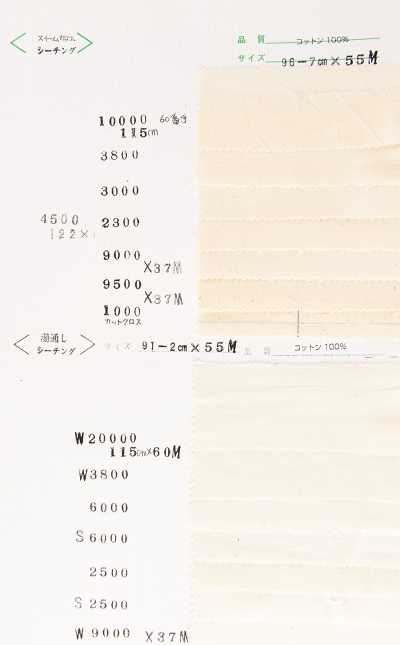
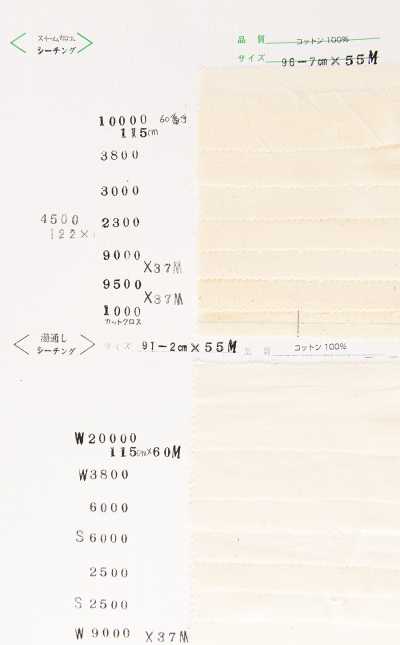
Steam-finished sheeting is mainly used for toile, mock sewing, and pattern checking. It is not a process used only on specific parts such as the body, sleeves, or collar, but a role for adjusting the condition of the textile used for trial production of the entire garment.
- Checking the shape of the pattern
- Checking the silhouette and ease
- Studying sewing specifications
- Checking modifications through fitting
Selection, Handling, and Sewing Precautions
For toile use, it is important to choose sheeting with thickness, crispness, drape, and stretch close to those of the actual fabric. In addition to whether it has been steam finished, check the structure, fabric weight, density, and grain stability, and match the usage accordingly.
Before cutting, unroll the bolt and check for distortion and the grain line of the textile. When dimensional accuracy is especially important, perform a preliminary test according to the care label and processing details of the textile being used, and check changes after cutting and sewing.
During sewing, be careful of stretching, pressure marks, and shine caused by excessive use of a steam iron. Especially on lightweight fabrics, use a pressing cloth and appropriate temperature settings, and press without pulling the area around the seam more than necessary.
Differences from Similar Terms
Shrink-proof processing is a process whose main purpose is to suppress shrinkage caused by washing and similar factors. Steam finishing also has the effect of stabilizing dimensions, but from the process name alone, shrink-proof performance and its degree cannot be treated as the same thing.
Prewashing is the work of treating textile with water or hot water before cutting in order to confirm and reduce shrinkage and color loss in advance. Steam finishing is often carried out as a finishing step for textile, and its process and purpose differ from the prewashing done by the user.
Frequently Asked Questions
Does steam-finished sheeting not need prewashing?
It cannot necessarily be said to be unnecessary. Even with steam-finished textile, the degree of dimensional change due to washing or moisture differs depending on the material and processing conditions. For trial pieces that will be washed or for applications requiring dimensional accuracy, make a judgment after checking shrinkage and changes in the grain line with a small test piece.
Is steam finishing the same as shrink-proof processing?
No, they do not mean the same thing. Shrink-proof processing is a treatment intended to suppress shrinkage, while steam finishing is a process that relaxes the tension in textile with steam and adjusts its hand feel and condition. Actual performance is checked in the specifications for each textile.