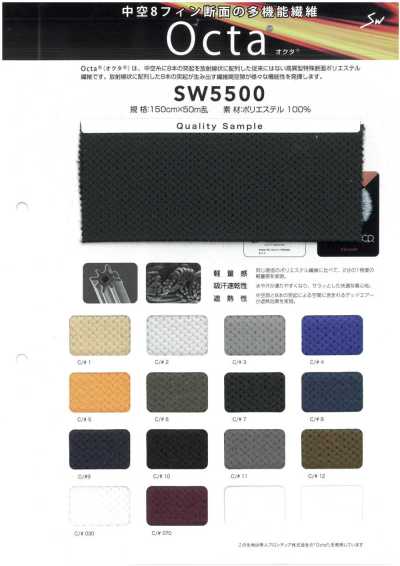
Interlaced Yarn
Interlaced yarn is a yarn in which compressed air is blown onto a bundle of synthetic fiber filaments to partially entangle the yarns and give it cohesion.


Contents6 sections
Definition and Overview
Interlaced yarn is a processed yarn made by applying an air stream to filament yarn formed by bundling multiple continuous filaments, creating interlacing points in part of the yarn bundle. Interlacing points are the parts where the filaments are intertwined, and they help keep the yarn together.
Unlike the method of applying twist to obtain cohesion as a single yarn, interlacing adds cohesion through partial entanglement created by air. As a result, it can adjust yarn handle and surface feel in ways that cannot be expressed by twist count alone.
Features
Interlacing can reduce filament irregularity and may make the yarn easier to handle in processes such as warping, weaving, and knitting. On the other hand, fuzziness, bulkiness, and softness vary depending on interlacing strength, spacing, and the type of base yarn.
In appearance, it basically has the uniformity typical of filament yarn, but the look changes depending on the interlacing conditions and subsequent finishing. The name interlaced yarn alone does not determine performance such as luster, stretchability, or quick-drying moisture absorbency.
- Interlacing points make the filament bundle easier to keep together.
- Unlike twisted yarn, it is not processed by giving continuous twist to the entire yarn.
- Feel and physical properties should be checked together with the fiber material, fineness, interlacing conditions, and finishing.
Main Applications
Interlaced yarn is often used in filament yarns such as polyester and nylon, and becomes the raw material for woven and knitted fabrics. In apparel, it is used widely according to the required fabric design, including shirts, blouses, sportswear, linings, outerwear, and uniforms.
Seasonality cannot be determined by the presence or absence of interlacing alone. Whether the fabric is lightweight or heavy, its weave, density, and fabric weight all affect comfort and warmth during wear, so it is important to confirm these in prototype testing of the final fabric.
Selection and Handling Notes
When selecting, check not only whether it is interlaced, but also the raw material, number of filaments, yarn thickness, twist, whether false twist is used, and the weave or knit structure. For fabric samples, evaluate surface uniformity, firmness, drape, and the appearance around seams according to the intended use.
Shrinkage and dimensional change after washing are not determined uniformly by interlacing processing alone. Because they are affected by heat-setting conditions, dyeing and finishing, structure, and blend ratio, washing tests and shrinkage checks should be performed before mass production. In sewing, check fabric slippage, stretch, and the visibility of needle holes, and adjust the needle, thread, and feed conditions.
Differences from Similar Terms
False-twist processed yarn is yarn given crimp, stretchability, and bulkiness by using heat and twist. Interlaced yarn is processed mainly by tangling filaments with air, and its purpose and resulting properties differ from false-twist processing. There are also yarns that combine both processes.
Twisted yarn is yarn in which twist is added by rotation to a single yarn or multiple yarns. Interlaced yarn may be given cohesion as a substitute for or supplement to twist, but the key difference from twisted yarn is that the interlacing points are localized.
Frequently Asked Questions
How is interlaced yarn different from twisted yarn?
Twisted yarn is given continuous rotational twist to adjust cohesion and feel, whereas interlaced yarn uses compressed air to partially entangle filaments. Because the degree of cohesion changes with interlacing strength and spacing, fabric evaluation is necessary for each processing condition even when the material is the same.
Does fabric made with interlaced yarn shrink when washed?
Shrinkage cannot be determined by the presence or absence of interlacing alone. Fiber material, heat setting, dyeing and finishing, weave or knit structure, and density all have an effect. For products intended for home washing, the specifications should be decided by checking the dimensions, appearance, and feel after washing using fabric close to mass-production conditions.