Ratchet Buckle
A ratchet buckle is a buckle that incrementally holds the toothed edge on one side of a belt or tape with an internal pawl, allowing length adjustment without using holes.
Contents7 sections
Definition and Overview
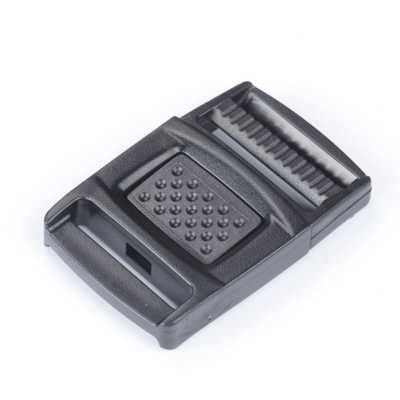
A ratchet buckle is a hardware fitting that threads the end of a tape or belt through the main body and secures it by engaging an internal pawl with toothed ridges. When the release part such as a lever is operated, the pawl disengages, allowing the length to be loosened or the belt to be removed.
Unlike a typical perforated belt that fastens at fixed hole positions, it can be adjusted finely at each toothed pitch. "Holeless belt" may refer to this type of belt, but it can also refer more broadly to belts without holes.
Materials and Structure
The main body is made of metal such as die-cast material, or resin such as polyacetal. Metal versions are easier to give a textured appearance and rigidity, while resin versions are relatively lightweight and are also used for tape adjustment parts in bags and outdoor goods.
The structure consists of an insertion opening for passing the belt through, a pawl that holds the toothed ridges, and a release lever or button that moves the pawl. On the belt side, either toothed tape for ratchet use or belt material with toothed ridges processed on the back side may be used.
- For metal versions, check for discoloration or corrosion of the plating caused by sweat, moisture, or friction.
- For resin versions, check for cracking in low-temperature environments and wear of the pawl due to repeated operation.
- As a rule, use the buckle body and the belt-side toothed ridges in a matching combination.
How Sizes Are Expressed
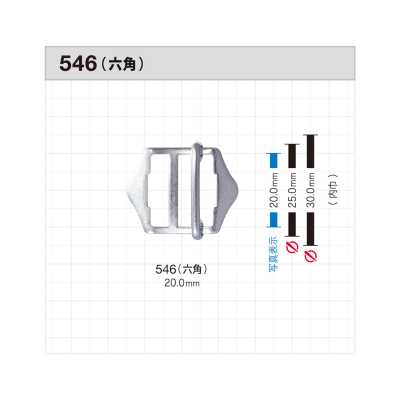
When selecting one, check the inner dimension of the part through which the belt or tape passes, not the outer dimensions of the buckle. The inner dimension corresponds to the width of the tape to be passed through, and you should choose one that matches the tape width or allows the clearance required by the specification.
Thickness is also important. If the tape is too thick, insertion and release become difficult; if it is too thin, the pawl may not hold securely. Confirm the actual combination by using the product itself, including the shape, pitch, and direction of the toothed ridges and the finishing of the belt end.
Main Applications
It is mainly used for waist adjustment on men's and women's belts. Because it is less dependent on hole positions, it is suitable for products that emphasize fine adjustment while being worn. Metal versions with a decorative design may be used for fashion belts, while lightweight resin versions may be used for adjustment mechanisms in bags and equipment.
However, even with the same ratchet mechanism, the required performance differs between belts and load-bearing equipment. For applications related to human safety or those bearing large loads, select parts whose strength is confirmed for the intended application.
Selection and Precautions
In addition to the belt width, thickness, and toothed ridge specification, confirm whether it can hold sufficiently in the assumed pulling direction. For products with frequent attachment and removal, evaluate the pawl engagement, ease of release operation, and whether slipping occurs after repeated use during the prototype stage.
Metal buckles are affected by weight in terms of wearing comfort and how the belt hangs. Depending on sweat, moisture, washing, or cleaning conditions, consideration must be given to rust, discoloration, and peeling of the plating. For products that require nickel consideration, also check the surface treatment and content information.
For products subject to needle detection, metal buckles should be assumed to react to the needle detector when designing the process. Even when needle detector compatibility is required, do not judge based only on the part marking; confirm using the actual product configuration and the needle detection conditions used.
- Evaluate holding force including the tape material, toothed ridges, and sewing or fixing method.
- For heavy clothing and bags, confirm that the specification matches the expected load.
- For applications exposed to water or sweat, confirm corrosion resistance and surface treatment.
- A ratchet buckle for a belt has a different locking structure from a simple slide adjuster or ladder lock.
Differences from Similar Terms
A ladder lock is a buckle that folds back the tape and adjusts and secures the length by friction. A ratchet buckle retains the belt by engaging a pawl with toothed ridges, so the basic fixing principle is different.
A GI buckle generally refers to a simple belt fitting that passes the belt end through and secures it by friction. A side-release buckle is a part that connects by inserting the male and female sides, and it does not primarily aim for continuous length adjustment by toothed ridges like a ratchet buckle.
Frequently Asked Questions
What is the difference between a ratchet buckle and a normal belt buckle?
A general pin buckle secures the belt by passing a prong through a belt hole. A ratchet buckle holds the toothed ridges on the belt side with a pawl inside the body, allowing step-by-step length adjustment without making holes. However, it cannot be used with belts whose toothed ridge specifications do not match.
Where should I check the size of a ratchet buckle?
First, check the inner dimension of the part through which the belt or tape passes and the width of the belt to be used. In addition, it is necessary to confirm the compatible thickness, the pitch and direction of the toothed ridges, and the insertion direction. Since fit cannot be judged from the outer dimensions alone, confirming threading and holding in a prototype is important.
Can a metal ratchet buckle be detected by a needle detector?
In many cases, metal versions will react to a needle detector, but the degree of reaction varies depending on the material, shape, detector settings, and position within the product. Do not decide whether it is compatible with needle detection based only on the part marking; confirm it under the needle detection conditions used with the finished product or a state close to it.