Venetian Lace
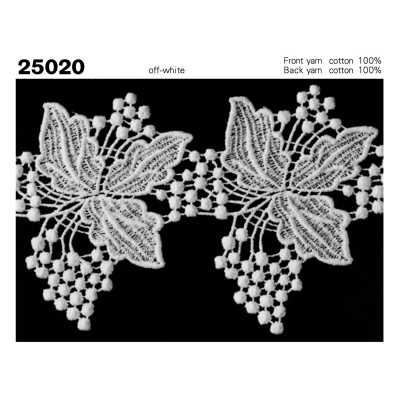
Venetian lace is a heavy lace characterized by bold raised patterns outlined with thick cord, while keeping the net-like ground fabric inconspicuous.
Contents6 sections
Definition and Overview
Venetian lace is a lace in which motifs such as flowers and plants are outlined with thick cord, suppressing the sheerness of the ground fabric to make the pattern stand out. The name comes from Venice, Italy, and it is also called Venice lace.
It may refer to designs derived from handmade needle lace, but in apparel materials, machine-made products are also called Venetian lace. The method is not determined by the name alone, so the actual product and specifications must be checked.
Construction and Materials
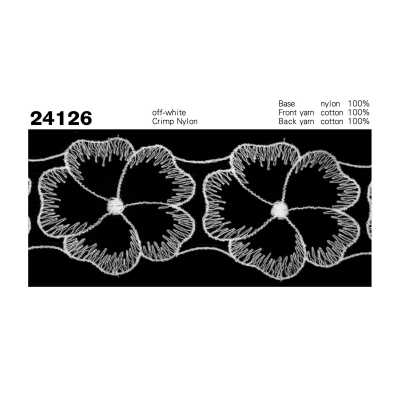
Traditional types are needle lace made by stitching patterns with needle and thread without using a fabric base. In modern apparel materials, it is often expressed through embroidery that emphasizes the pattern with cord, chemical lace, and similar methods.
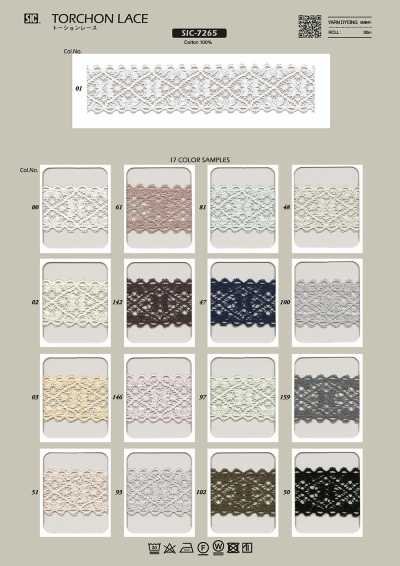
Materials used include cotton, rayon, polyester, nylon, and others. Depending on the material, yarn thickness, and finish, flexibility, firmness, thickness, and suitability for washing vary greatly.
Appearance Characteristics
Its features are the raised texture created by cord that outlines the edges and the large motifs with openwork sections. Compared with lace that shows the pattern on a fine net ground, it tends to have a more sculptural and striking appearance.
Some versions have scalloped pattern edges, and some motifs can be used separately after cutting. Because thick patterned sections and sheer sections coexist, the appearance changes depending on the color of the fabric underneath.
Main Applications
It is used for dresses, blouses, skirt panels, collars, cuffs, and hem decoration. Its three-dimensional quality is easy to showcase, so it is also used for formal wear, costumes, and lingerie decoration.
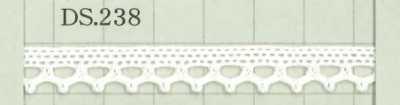
Tape-like types are used as edging, while wide-width types are used as parts such as yokes and bodices. When used in sections, check the motif direction and edge shape, and arranging them symmetrically produces a neat finish.
Selection and Handling Notes
Check the width, motif size, cord thickness, edge treatment, and sheerness according to the intended use. Stretchability varies depending on the material and construction, and non-stretch items should not be used alone in areas that will be under stress during wear.
When cutting, determine the motif placement so as not to damage the pattern, and baste if necessary. Since cut edges may fray or threads may come loose, consider finishing methods suitable for the product and lace, such as sewing into the seam allowance, hand whipstitching, or bonding.
Wash according to the fiber composition and care label. Raised cord and delicate openwork sections are easily affected by friction and snagging, so using a laundry net, washing with gentle action, and drying flat after shaping may be suitable.
Frequently Asked Questions
Are Venetian lace and chemical lace the same?
No, they are not the same. Venetian lace is used as a name for a three-dimensional design or appearance outlined with thick cord. Chemical lace refers to a method in which a water-soluble base fabric is removed after embroidery to leave the pattern behind. Chemical lace can be used to create Venetian-style patterns.
Does Venetian lace stretch?
Whether it stretches is not uniform. Items containing polyurethane or using a stretch base fabric will stretch, but there are also many non-stretch items reinforced with cord. Check the stretch in the width and length directions, recovery, and deformation caused by pulling during sewing before use.
How should the edges of Venetian lace be finished?
If a finished scalloped edge or similar selvage can be used, it can be used as is for hems or collar edges. Cut edges are basically sewn into the seam allowance. When using as a motif, reinforce as appropriate for the pattern and material, such as by closely hand whipstitching near the outline to prevent threads from coming loose.
- Search products for "Venetian lace"
- Products with material "Cotton"
- Products with material "Polyester"
- Products with material "Nylon"
- Products with material "Rayon"
- Products for style "For Lingerie"
- Products for style "For Formal Wear"
- Products for style "For Costumes/dresses"
- Products for style "For Skirts And Dresses"
- Browse Lace products