Batten Lace
Batten lace is a dimensional openwork lace in which tape lace or cord is arranged according to a design and the spaces are joined with overcasting or decorative yarn to create the pattern.
Contents6 sections
Definition and Overview
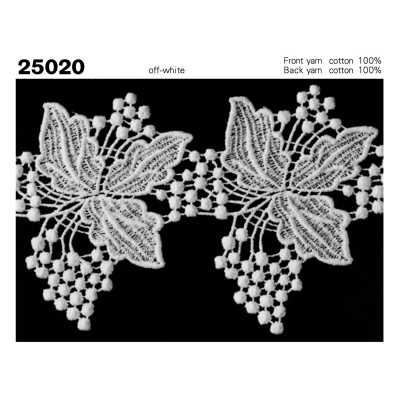
Batten lace is a type of lace constructed by arranging pre-made tape-like lace or wide cords into flowers, leaves, geometric patterns, and similar designs, then joining the intersections and gaps with thread. It is characterized by a clear, defined design that makes use of openwork areas.
Unlike lace that creates patterns by weaving or knitting throughout the entire fabric, the tape itself that forms the motif takes center stage. It is often used as a partial decorative material, and the finished appearance varies depending on the width, motif layout, and edge finishing.
Construction and Materials
Traditionally, linen or cotton tape is secured to a pattern on a backing sheet, and the spaces between the tape are joined with overcasting, overcasting thread, picots, and similar techniques. Picots are small looped decorations made at the edge or joining sections. Today, machine-made products are also available.
Materials such as cotton, linen, and polyester are used, and depending on the material and yarn thickness, the appearance ranges from natural to delicate and lustrous. It is important to check not only the blend ratio, but also the thickness and stiffness of the tape section and the joining yarn.
Visual Characteristics and Main Uses
Because the contour drawn by the tape contrasts with the openwork created by the joining threads, this is a lace that easily creates shadow and dimensionality. Floral patterns tend to give a classic, handmade impression, while linear or geometric patterns can produce a relatively clean look.
It is used not only for decorations such as collars, cuffs, hems, and yokes on blouses and dresses, but also for dress seams, bags, accessories, and interior decor. Because it is sheer, when used over large areas of clothing, the layering with lining or another fabric should be considered in advance.
- Partial decoration for collars, plackets, cuffs, and similar areas
- Seams and seam lines on dresses and gowns
- Accents for bags, accessories, and interior decor
How to Choose and Handling Precautions
When selecting it, check the motif size, tape width, density of the openwork sections, and edge specifications. Because the pattern can be interrupted depending on the cutting position, allow not only for the required dimensions but also for extra allowance needed for pattern matching and seam allowance. Before sewing, check needle holes, thread breakage, and seam shrinkage with a test stitch.
Many types of batten lace itself are not stretchy materials, but the openwork sections tend to deform if pulled. Care is also needed to prevent snagging when storing on hangers or wearing. For washing, follow the product care label, avoid friction and twisting, and consider using a laundry net and laying flat to dry.
If the tape edges or joining threads are damaged, fraying or partial unraveling may occur. When sewing it in place, do not pull strongly on only the openwork sections; hold and secure the tape portions properly. When pressing, use a pressing cloth and check on an inconspicuous area to avoid flattening or distortion.
Differences from Similar Terms
Chemical lace is made by embroidering on a base fabric and then dissolving the base fabric to leave only the embroidered motif. Batten lace differs in that the design is formed by combining tapes. Since both can appear as openwork patterns without a base fabric, it is easier to distinguish them by checking whether there is a tape-like outline.
Torsion lace is a type of bobbin lace made by combining multiple threads. Leavers lace also expresses delicate patterns with fine thread, but batten lace is characterized by clear outlines made from relatively wide tape or cord, and the openwork in the joining sections.
Frequently Asked Questions
Does batten lace stretch?
In general, batten lace is not a highly stretchable material unless it contains polyurethane or similar fibers. However, the openwork sections and joining threads can easily distort when pulled, so it is important not to apply excessive tension during sewing, wear, or storage.
Can batten lace be washed at home?
What should I watch out for when sewing batten lace onto fabric?
If you sew only through the openwork sections, thread breakage and distortion are more likely to occur. As much as possible, sew down the tape portions to preserve the outline of the design. When attaching it to lightweight fabric, confirm seam puckering and the visibility of interfacing or reinforcement fabric with a prototype before mass production.