


Yagasuri
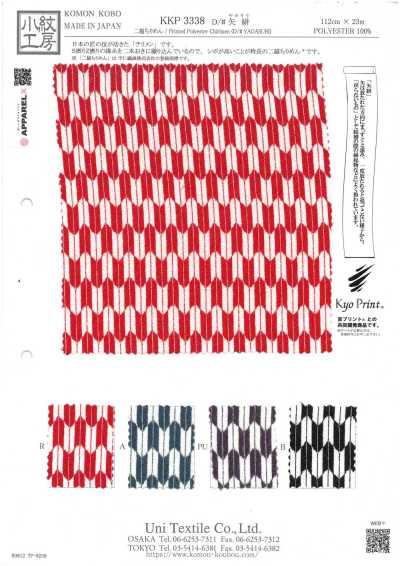
Yagasuri is a continuous pattern stylized from arrow feathers, a Japanese-style motif used not only in traditional kasuri expressions but also in prints and woven patterns.
Contents6 sections
Definition and Overview
Yagasuri is a pattern that depicts the feathers attached to the back of an arrow with diagonal lines or chevrons. It is based on repeating a unit motif in a consistent direction, making it a design that conveys sharpness, movement, and a neat, orderly impression.
Although the name includes "kasuri," Yagasuri is mainly the name of a pattern. While it may be expressed through kasuri, in which yarns are dyed in sections and woven, fabrics with arrow-feather motifs printed or woven in Jacquard are also called Yagasuri.
Pattern Formation and Types
Yagasuri includes designs in which the tips of the arrow feathers face in one direction, upward or downward, ones that alternate left and right, and ones that combine large and small motifs. Depending on the color scheme and pattern scale, it can be adjusted from a traditional impression to a modern, geometric one.
In traditional kasuri, the warp yarns, the weft yarns, or both are dyed in advance so the pattern appears when woven. For that reason, the outlines may have a blurred appearance, but this is a characteristic of the kasuri technique rather than of the arrow-feather pattern itself.
Main Uses and Seasonality
It is used for kimono fabric and obi accessories, as well as dresses, skirts, blouses, shirts, and bags. Because it is a regular pattern, it can serve as the main design element even in a single item, and it is also suitable for switching with solid fabric or for partial use.
Yagasuri is a pattern, so it does not determine the season. If the material is light and breathable, it is suitable for spring and summer; if it has a brushed feel or thickness, it can be used for autumn and winter. Seasonality is judged by combining the material, fabric weight, sheerness, and construction details.
Fabric Selection and Cutting Notes
The direction of the arrow feathers greatly affects the appearance of the product. Using it vertically makes the eye flow up and down more easily, while horizontal or diagonal use changes the impression. At the planning stage, it is important to decide the direction of the arrow tips as seen from the front and how the pattern is handled on the left and right body panels.
If the pattern shifts at the center of the front body, collar, placket, pockets, or side seams, it becomes noticeable, so the reference position for the pattern should be specified on the pattern. Larger patterns increase the restrictions on cutting positions and the amount of fabric needed for pattern matching, so the required length should be checked with the pattern repeat in mind.
- For one-way patterns, align the top and bottom direction of all parts when cutting.
- To make it look symmetrical left to right, align the motif position using the center front as the reference.
- At facings and pocket openings, check the continuity of the pattern with the outer fabric.
- For irregular kasuri-style materials with unclear pattern outlines, appearance balance may take priority over perfect matching.
Differences from Similar Terms
Kasuri refers to a technique for weaving dyed yarns to create a blurred pattern, or to the fabric made that way. Yagasuri is the name of a pattern that represents arrow feathers, and it is used to include arrow-feather patterns made by methods other than kasuri.
Ikat is a term used for woven fabrics and patterns that express a design by dyeing the yarns in advance, and it is a concept close to kasuri. Yagasuri, on the other hand, refers to the shape of the motif, so it is not a word that directly indicates the manufacturing method.
Frequently Asked Questions
Do Yagasuri and arrow-feather pattern mean the same thing?
In many cases, both refer to a pattern that stylizes the feathers of an arrow and are used with nearly the same meaning. However, the name Yagasuri may also evoke traditional kasuri textiles. When selecting fabric, check not only the pattern name but also whether it is printed or woven, and whether it is expressed as kasuri.
Does Yagasuri require more fabric length than solid fabric?
Depending on the size of the pattern, the pattern repeat, and whether pattern matching is needed on the body panels or pockets, more allowance than with solid fabric may be required. In particular, one-way patterns and large patterns require the top and bottom direction to be aligned, so the required amount should be calculated after confirming the pattern layout.





