Yoke
A yoke is a fabric section or construction detail placed at the shoulders, back, chest, or waist area of a garment to create a panel seam in the body.
Contents6 sections
Definition and Overview
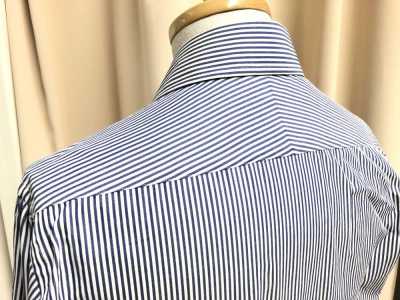
A yoke is a seam section that forms the upper part of a body panel as a separate piece. The back yoke placed from shoulder to shoulder on the back of a shirt is typical, but it is also used on the front body, sleeves, and around the waist of skirts and pants.
As a design seam line, it can also serve to help the shape fit the shoulders and back, or to stabilize areas that are subject to stress. In constructions that use lining or interlining, it is also involved in reinforcement and silhouette retention.
Position in Product Development
The specifications for a yoke are considered from both design and comfort at the planning stage, and the pattern determines the seam position, shape, seam allowance, and grain line. After that, the spec sheet states the sewing method, stitching, whether interlining is used, and the standards for pattern matching, then gives instructions for cutting and sewing.
In sewing, the yoke and body are sewn together, and as needed the seam allowance is pressed open, pressed to one side, or secured with stitching. For shirts that are neatly finished on the inside as well, there is also a construction in which the yoke is doubled to enclose the seam allowance.
- Back yoke: A yoke placed across the back shoulders of a shirt or blouse.
- Front yoke: Used for design around the chest area and for raised seam styling.
- Waist yoke: A band-shaped or curved piece that changes the construction around the waist of a skirt or pants.
- Split yoke: A specification in which the back yoke is divided left and right at the center, with a seam at the middle.
Design and Development Points
Seam lines affect not only appearance but also range of motion and the amount of ease. For a back yoke, check the shoulder slope, the amount in the back body, and the connection to the armhole, and in the prototype confirm that there is no pulling, gaping, or strain around the shoulders.
With stripes or checks, the yoke and body may have different pattern directions, or the pattern may continue across them. It is important to decide during planning where to match and whether to prioritize how the pattern appears, and to share that in the pattern and cutting instructions.
Points to Note for Ordering and Quality
For the factory, clearly communicate the number of yoke pieces, front and back handling, the area to be interfaced, the direction for pressing the seam allowance, and the stitch position and thread color in the spec sheet and sewing sample. Double yokes and split yokes have different processes, so confirm the sewing method before mass production.
During inspection, check for left-right shape differences, waviness in the seam line, twisting of the seam allowance, crooked stitching, and pattern misalignment. Thin fabrics, highly stretchable materials, and yokes cut on the bias tend to stretch, so determine in advance whether interfacing or stay tape is needed.
Differences from Similar Terms
A yoke is the name of a garment component or seam section. A dart is a sewn-out section used to add three-dimensional shape to flat fabric, and it does not always refer to an independent seam piece like a yoke.
A back facing usually refers to reinforcement fabric or a back-side piece applied to the inside of a garment's back section, and its purpose and appearance differ from a yoke, which is visible as an outer seam. However, depending on the construction, it may be used in a position close to the back yoke.
Frequently Asked Questions
Is a yoke always added for reinforcement?
No, reinforcement is not the only purpose. It is added for design created by seam changes, for fit at the shoulders and back, for distributing ease, and for sewing or pattern-use detailing. Depending on the material and garment type, it may also provide reinforcement through interlining or a double construction.
What is a split yoke?
A split yoke is a specification in which the back yoke of a shirt is divided into left and right halves at the center back. The center seam allows adjustment of the grain line and how the pattern appears, and it is also used when placing the pieces to match the left and right shoulder directions.
What should be checked when matching the pattern on a yoke?
With checks and stripes, confirm pattern continuity with the body, left-right symmetry, and the pattern position at the center of the yoke. Because the pattern direction may intentionally be changed, it is important to prepare instructions showing the finished appearance and to agree before cutting and with sewing samples.