Chest Pad
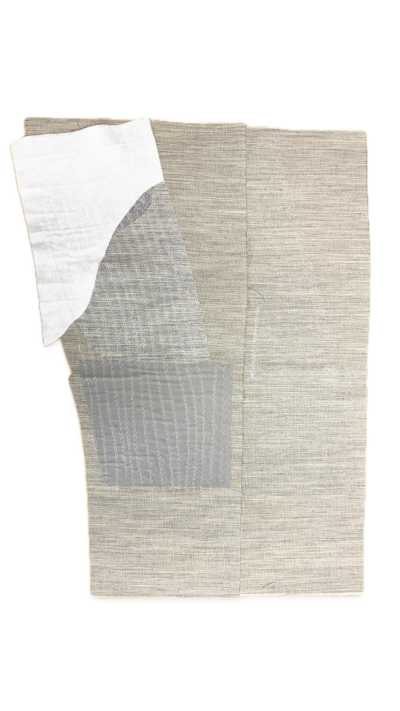
A chest pad is a partial interfacing used mainly in the chest area of the front panels of tailored jackets to add shape to the chest, suppress distortion of the outer fabric, and improve the finished appearance.


Contents6 sections
Definition and Overview
A chest pad is a partial interfacing used over the chest area of the front panels of a jacket. It adds appropriate thickness and support around the chest, creating a natural rounded shape from the lapel to the chest and a stable appearance in the front panel.
It is characterized by the fact that it is not an interfacing used over the entire garment, but one used to reinforce and shape only the necessary areas. It may also be handled in a pre-cut shape, and the form is selected according to the jacket specification, such as single or double-breasted styles.
Areas of Use and Role
The main area of use is the chest of the front panels of tailored jackets. It is placed between the outer fabric and the interfacing for the front panel, or depending on the specification, on the inside of the interfacing, helping maintain chest fullness while keeping the front panel from collapsing when worn.
With thin or soft outer fabrics, a chest pad makes it easier to compensate for a lack of surface firmness. On the other hand, if the interfacing is too firm, only the chest area may stand out unnaturally, so the chest’s dimensionality, lapel roll, and overall silhouette should be considered together.
- Enhance chest dimensionality
- Prevent distortion and collapse of the front panels
- Stabilize the line from the lapel to the chest
- Partially compensate for thin or soft outer fabric
Materials and Types
Chest pads are made from woven fabrics, nonwoven fabrics, and interlinings containing wool, and the finished result varies depending on thickness, firmness, resilience, and whether they are fusible. There are types ranging from thin, lightweight versions that prioritize lightness to firmer types that make it easier to create a structured chest.
Fusible types are bonded to the outer fabric or interfacing by pressing, which makes the work easier. Sew-in types are used according to the sewing specification and tailoring method, and are sometimes chosen when a softer three-dimensional shape is desired that is difficult to achieve with fusing alone.
Selection and Precautions for Fusing and Sewing
If the outer fabric is thin, soft, or has a strong drape, start by checking a chest pad with reduced thickness and firmness. Conversely, even when a solid jacket-like chest structure is desired, if the firmness exceeds that of the outer fabric, it may cause press marks on the surface or unnatural ridges.
For fusible types, check the bonding conditions such as temperature, time, and pressure specified for each interlining, and test it with the outer fabric before full production. After fusing, check for peeling, bubbling, strike-through, and any change in the texture of the outer fabric.
During cutting, align the grain and left-right symmetry, and during sewing, take care that the edges of the chest pad do not show through the outer fabric. In areas where thickness overlaps, it is important to blend the step by finishing the seam allowance and pressing it flat.
Differences from Similar Terms
Haircloth interlining is a type of interlining, or a general term for interlinings, used mainly in tailored garments to support structures including the entire front panel and lapels. A chest pad is treated as a partial interfacing added for the purpose of reinforcing and shaping the chest area.
Fusible interlining is a general term for interlinings bonded with heat and pressure. Chest pads also include fusible types, but the term chest pad does not refer to the bonding method; it indicates the purpose and area of use on the chest. Non fusible interlining is a tailoring concept in which the interfacing is not fully bonded to the outer fabric and is held in place by sewing.
Frequently Asked Questions
Is a chest pad always necessary for a jacket?
No, it is not always necessary. It may not be used in lightweight tailoring or in specifications where the outer fabric itself has sufficient body. The decision depends on the chest’s dimensionality, how it looks when worn, the thickness and softness of the outer fabric, and the desired tailoring style.
Are a chest pad and fusible interlining the same thing?
No, they are not the same. A chest pad refers to a partial interfacing used in the chest area, while fusible interlining refers to an interfacing bonded with heat and pressure. Therefore, there are chest pads that are fusible, and chest pads that are sewn in.
What problems can occur if a chest pad is too firm?
If the firmness or thickness of the interfacing stands out more than the outer fabric, only the chest area may appear overly pronounced, or the edge of the interfacing and press marks may show on the surface. A trial piece layered with the outer fabric is pressed, and the fit when bent and the appearance are checked before selection.