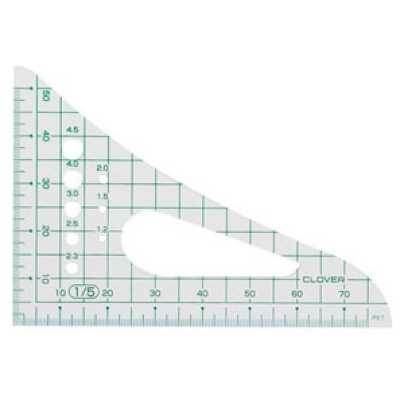
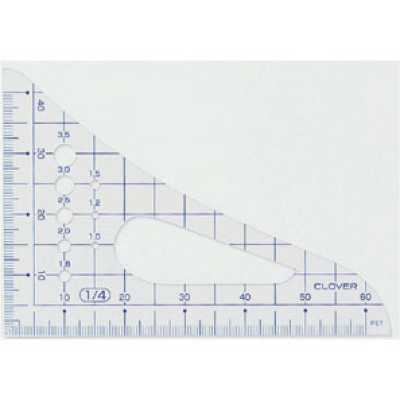
French Curve
A French curve is a ruler used to trace a variety of curves that are difficult to draw with a straight ruler, allowing you to draw smooth lines for patterns and technical drawing.

Contents6 sections
Definition and Overview
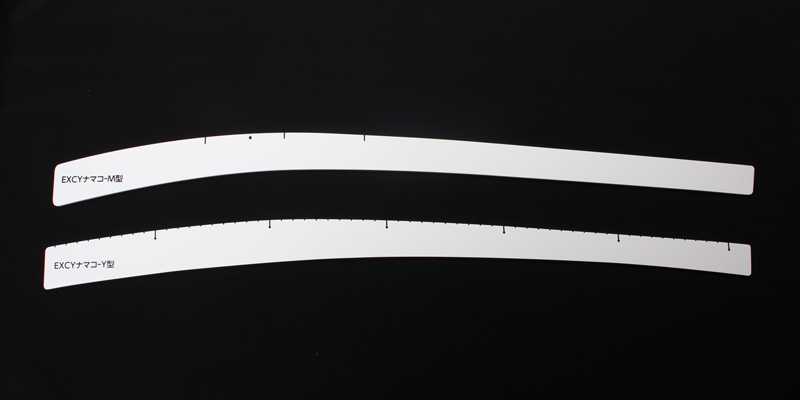
A curve ruler is a drafting ruler made up of outlines with multiple curvatures. It is used to refine the curves needed for garment patterns, such as the neckline, armhole, armscye, and hip line. It is generally also called a French curve.
The term cloud curve ruler is sometimes used as another name for a curve ruler. Depending on the product or educational setting, a curved ruler with a cloud-like outline may be called a cloud curve ruler in particular, so checking the shape and intended use is the safest way to identify it.
How to Use It
Find a position where the edge of the ruler naturally follows several reference points on the curve. Rather than trying to connect all points at once, change the ruler's angle where the curvature changes, and connect short lines to avoid unnatural kinks or bulges.
When making a pattern, first accurately enter straight lines, required dimensions, notches, and other reference marks, then draw the curve. After drawing, visually check for sharp corners or waviness, and for symmetrical parts, it is important to verify them by overlapping.
- Use your palm to keep the ruler steady so it does not move on the paper.
- Let the pencil or mechanical pencil lightly follow the ruler edge; do not press hard.
- When drawing a seam allowance line, first refine the curve of the finished line.
- Check the connection points of curves so the line joins smoothly.
Types and How to Choose
Small types with a limited range of curves are suitable for partial corrections and carrying around. Larger types with many curvatures are easier to use for long curves such as the body and sleeves, and are suitable for pattern work. Choose according to the size you are drafting and how often you use it.
Transparent resin types make it easier to see the lines and marks underneath, so they tend to be easy to use in drafting. Types that are thick and have smooth edges are more stable when drawing lines, so also check the paper type, writing instrument, and size that fits your hand.
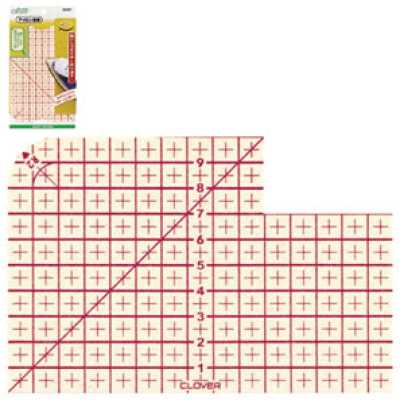
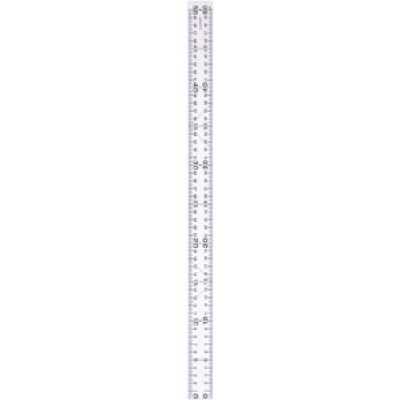
A gridded ruler makes it easy to draw straight lines, parallel lines, right angles, and check dimensions, and its role differs from that of a curve ruler, which is mainly for drawing curves. In practice, both are used together to distinguish between straight and curved sections.
Care and Safety Notes
After use, wipe off pencil dust and dirt with a soft cloth, and store it flat to prevent warping or scratches. Be careful in places that become hot or are exposed to direct sunlight, as resin rulers may deform.
If the ruler edge is chipped or deeply scratched, the line may become irregular or the paper may be damaged. Do not use it if damage is found. When cutting with a cutter, check whether the curve ruler is suitable for cutting use, and do not place your fingers in the blade's path.
Differences from Similar Terms
A tape measure is a flexible tool for measuring body or fabric length, and is not suited to accurately drafting a fixed curve. A curve ruler is a tool focused more on drawing smooth curved shapes than on measuring length.
A bone folder is a tool for making fold lines, marks, and temporary lines on paper or fabric, and is characterized by the fact that it can be used without writing tools. A curve ruler is used as a guide when drawing lines, and may be combined with a bone folder or tailor's chalk when marking curves.
Frequently Asked Questions
Can you draw pattern curves with only a curve ruler?
In many cases, you can draw curves such as the neckline and armhole with a curve ruler. However, patterns also require straight lines, right angles, parallel lines, and dimension checks. Using a gridded ruler and a tape measure together, and then refining the curves after accurately establishing the reference lines, makes the work easier.
What causes a line drawn with a curve ruler to look unnatural?
Causes include the ruler's curvature not matching the reference points, trying to connect a long curve all at once, and not adjusting the ruler's angle enough at the connection points. Choose a position that follows several points, draw in short sections, and check the flow of the line.