Foreign Matter
Foreign matter refers to unwanted substances other than fibers used in products, such as leaves, stems, seed fragments, pods, and soil mixed into raw fibers like cotton.
Contents6 sections
Definition and Overview
Foreign matter refers to non-fibrous substances that become mixed into fibers during the processes from raw material harvesting through storage and transportation. In cotton, typical examples include leaves, stems, and seed fragments, and they are removed as much as possible during the spinning process.
Short fibers are sometimes listed together with foreign matter, but they are originally fibers themselves and are treated separately from foreign substances such as leaf pieces. The amount and nature of foreign matter at the raw material stage affect the appearance and uniformity of yarn and textile.
Effect on Texture and Appearance
If foreign matter remains, small color spots, streaks, or coarse grain-like appearances may appear in the yarn or textile. The lighter the color, the whiter the textile, the finer the yarn count, and the smoother and glossier the textile, the more noticeable such differences in appearance become.
Yarn that has been thoroughly cleaned of impurities generally has less unevenness and is easier to produce a more even surface. This makes the appearance after dyeing and tailoring more uniform, while some materials intentionally make use of the remaining foreign matter as a rustic visual characteristic.
Main Applications and Material Selection
Yarn and textiles with reduced foreign matter are often chosen for applications that emphasize cleanliness and a smooth surface feel, such as shirts, blouses, dresses, and bedding. In particular, for light-colored items and print bases, it is important to check in advance for color spots and uneven appearance.
On the other hand, in casual clothing, bags, and interior applications that seek a natural, uneven look, graininess and color spots originating from the raw material may be treated as characteristics of the material. For each application, make it clear whether such appearance is acceptable or should be judged as a defect.
- When prioritizing appearance uniformity, check white and light-colored swatches.
- Even when making use of an undyed or natural look, set acceptance criteria for the size and amount of foreign matter.
- Because appearance may vary by lot even with the same textile, check before mass production.
Handling and Sewing Precautions
Foreign matter is mainly related to quality at the raw material and spinning stages, so it is not itself a direct cause of shrinkage from washing. However, because surface particles that may come off in washing and color spots remaining in the fibers are different in nature, confirm changes with a test wash.
In sewing, inspect before spreading and cutting so that color spots and streaks caused by foreign matter do not end up in positions where they will stand out after cutting. It is important to avoid areas with noticeable contamination when cutting and to share inspection criteria at the fabric inspection stage with the fabric supplier.
Differences from Similar Terms
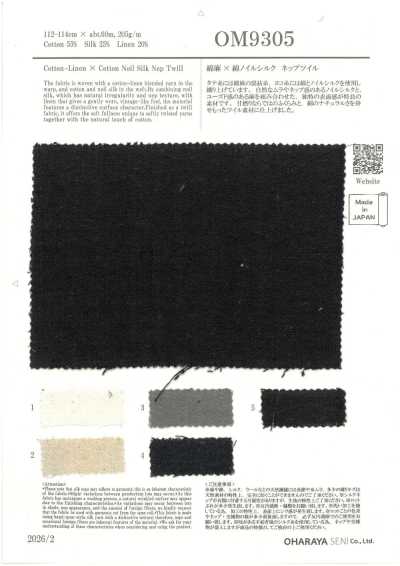
Nep refers to small knots formed on the surface of yarn or textile when short fibers and the like become entangled. While foreign matter mainly refers to non-fibrous unwanted substances, nep refers to surface changes caused by masses of fibers. Some nep is intentionally added as a design feature.
Fabric defects is a broad term for quality problems that include stains, weaving damage, uneven dyeing, and more. Foreign matter can be one cause or one visible manifestation of such problems, but not all fabric defects are caused by foreign matter.
Frequently Asked Questions
What difference does using yarn with less foreign matter make?
Generally, unevenness on the yarn surface is reduced, making it easier for the woven or knitted surface to become smoother. In light-colored textiles and fine yarns, fewer color spots or coarse grain-like appearances contribute to better tailoring appearance. However, the final appearance is also influenced by fiber type, spinning, weaving or knitting, and dyeing processes.
Are foreign matter and nep the same?
No. Foreign matter mainly refers to unwanted substances such as leaf pieces, seed fragments, and soil. Nep is a fiber knot formed by entangled short fibers and the like. However, because they may be difficult to distinguish from the appearance of the textile alone, checking the condition of the roll or yarn is necessary to identify the cause.