Pattern Weight
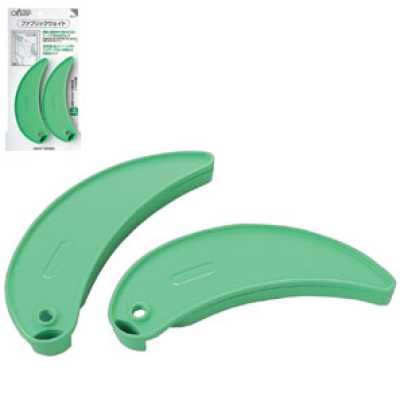
A pattern weight is a cutting weight with just enough heft to hold a pattern in place on fabric for cutting and marking without making holes with straight pins.
Contents6 sections
Definition and Overview
A pattern weight is a tool used to keep pattern pieces in close contact with fabric spread on a cutting table. It is placed around the pattern and at key points to prevent shifting, then the fabric is cut with a rotary cutter or similar tool. In addition to forms similar to those used for Japanese handwriting or calligraphy paperweights, there are flat round, bar-shaped, and pouch-shaped types.
Unlike the method of securing a pattern with straight pins, its defining feature is that it does not make pinholes in the fabric or pattern. It is especially useful for thin fabrics, coated fabrics, synthetic leather, and other materials that easily retain pinholes, as well as for samples where holes should be avoided.
How to Use
Lay the fabric flat along the grain line, and place it on a cutting mat if needed. After positioning the pattern, distribute the pattern weights mainly over areas that tend to lift, such as corners, curves, and the middle of long edges. It is important not to concentrate the weight in one area.
When cutting, keep the pattern fixed with the pattern weights rather than holding it down with one hand while moving the blade. With a rotary cutter, cut along the edge of the pattern and move any weights in front of the cutting direction as needed.
- Place them not only around the outer edge of the pattern, but also near narrow pieces and inside notches.
- Do not stretch elastic fabrics; fix them in their natural state.
- Adjust placement so that cutting lines and matching marks are not hidden by the weights.
- On long straight sections, check for any lifting or shifting along the way before cutting.
Types and Selection
When choosing one, check the shape, weight, slip resistance of the bottom surface, and surface finish. Flat, low-profile shapes tend to stay stable on patterns and are also suitable for rotary cutter work. Types with handles or bar-shaped designs are easier to reposition and move.
The weight needed depends on the thickness of the fabric, how slippery it is, the size of the pattern, and the cutting method. If it is too light, the holding force is insufficient; if it is too heavy, handling becomes more burdensome and the risk of dropping increases. Practical options are those that can be used in multiples and distributed where needed.
A smooth bottom surface and no sharp edges make it less likely to damage the fabric and easier to handle. For metal types, check the condition of the surface treatment as well. For light-colored or delicate fabrics where color transfer or scratches are a concern, you can also place clean cloth or thin paper between them.
Care and Safety Precautions
After use, wipe away fiber lint and dust, and store it in a dry condition. Metal types may rust due to moisture, so it is important not to leave them with water attached. Regularly check the bottom surface for scratches, peeling, or stickiness.
Because pattern weights are heavy, do not place them on the edge of a cutting table, and when carrying them, hold them steadily with both hands so they do not fall. When repositioning them near a blade, first retract the rotary cutter blade or move it to a safe position before working. Also avoid storing them where small children can reach them.
Differences from Similar Terms
A pattern weight is a tool that fixes a pattern with its weight; it does not pass through the fabric and pattern like a straight pin. Straight pins can also be used for three-dimensional temporary holding and pre-sewing securing, but pattern weights are mainly used for pattern layout, marking, and cutting on a flat surface.
In general, the term pattern weight refers to a weight used to hold paper in place, but a pattern weight for cutting refers to one that has the stability and surface shape suitable for cutting work. A cutting mat, meanwhile, is a sheet that protects the worktable from blades, and its role is different from that of a pattern weight that holds a pattern in place.
Frequently Asked Questions
If a pattern is secured only with pattern weights, will the fabric shift?
If you place a sufficient number of pattern weights appropriately according to the type of fabric and the size of the pattern, shifting can be reduced. In particular, fix corners, curves, narrow sections, and the middle of long edges more carefully. For slippery fabrics or highly stretchy fabrics, it is reassuring to check the fixed state with a test cut.
How do you use pattern weights and straight pins differently?
Pattern weights are suitable for fabrics where you want to avoid pinholes, or when you want to cut flat with a rotary cutter. On the other hand, straight pins are useful for temporary holding before sewing, securing three-dimensional shapes, and aligning detailed sections precisely. Use them according to how easily the material is damaged and the stage of the work process.