


Bead Embroidery
Bead embroidery is a decorative technique that uses a needle and sewing thread to sew beads onto fabric one by one or in a continuous line, creating patterns, dimensionality, and luster.
Contents6 sections
Definition and Overview
Bead embroidery is an embroidery technique that threads pierced beads onto yarn and stitches them onto the surface of the fabric. It can be expressed by arranging them along outlines, fastening them to fill in areas, or combining them with other embroidery yarns or sequins.
Whereas ordinary thread embroidery shows the lines and surfaces made by the yarn itself, bead embroidery mainly makes use of the decorative qualities of the beads’ shape, color, transparency, and reflection. It is used in a wide range of applications, from partial decoration on clothing to accessories and bags.
How to Use It and Main Techniques
Beads can be sewn down one by one, threaded several at a time and secured at regular intervals, or secured on both sides of a bead line. Placing them on pattern outlines, flower centers, collars, or around pockets, where there is relatively little friction, makes it easier to bring out the design.
For thin fabrics or fabrics that stretch easily, it is necessary to control fabric sagging by stretching the fabric appropriately in an embroidery hoop or adding interfacing or reinforcing cloth to the back side. In products, also check the back-side thread finishing and comfort against the skin after embroidery.
- Single-bead fastening is suited to fine patterns and irregular arrangements.
- Continuous fastening is suited to outlines and band-like decorations.
- For area filling, the appearance changes depending on the density, color arrangement, and bead orientation.
- When a raised finish is desired, base embroidery or core materials may be used together.
How to Choose Beads and Tools
Round, tube-shaped, and cut beads differ in their reflection and appearance. Check not only the bead size, but also the hole diameter, thickness, weight, colorfastness, and durability of the surface finish, and match them to the fineness of the design and the intended use. For beads with small holes, you need to choose a needle and yarn that can pass through them.
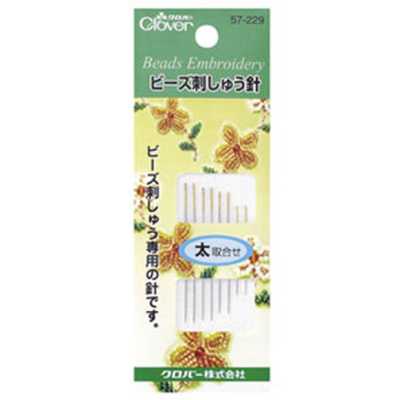
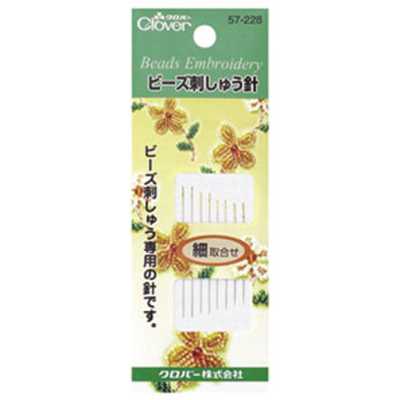
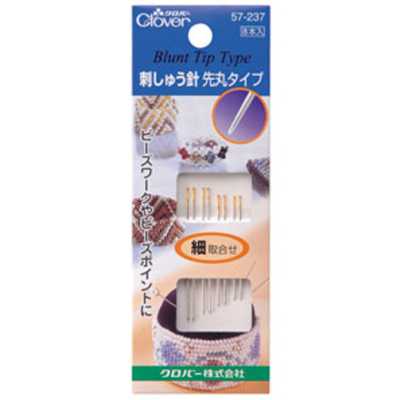
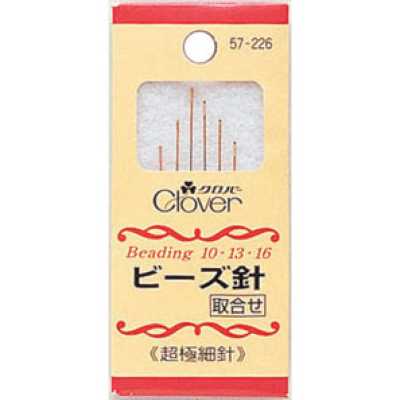
Bead needles are sometimes thinner and longer than ordinary sewing needles, making them easier to use for small beads. However, thin needles bend easily, so avoid forcing them through thick fabrics or repeatedly through hard materials. Choose the yarn based on how easily it passes through the bead holes, its strength, color, and how well it blends into the finish.
- Small beads with stable hole diameters are suitable for delicate patterns.
- For garments with movement, consider lightweight shapes that are less likely to snag.
- For thick fabrics or hard base cloths, test needle breakage and strain on the fabric in advance.
- In mass production, check in advance for bead color variation, shape variation, and clogged holes.
Care and Safety Precautions
Products with bead embroidery differ in their resistance to washing and cleaning depending on the bead material, surface finish, and stitching method. Strong friction, twisting, and long exposure to water can cause beads to come off, discolor, or scratch, so follow the care instructions for each product.
When ironing, do not apply heat or pressure directly to the beads; iron from the back at low temperature or use a pressing cloth. Be careful of snagging during wear, and because detached beads may be swallowed accidentally, securing stitch strength and controlling part detachment are especially important for products intended for children.
Differences from Similar Terms
Embroidery refers broadly to techniques for creating patterns on fabric with yarn. Bead embroidery is one form of decorative expression, and its defining feature is sewing beads down. Embroidery yarn may be used together with it, but it can also be composed entirely of beads.
Sequins are decorative pieces such as flat discs that are sewn on, and their shape and appearance differ from beads. Luneville embroidery is a technique that uses a crochet hook-like tool to fasten beads and sequins continuously, and it may be treated as one method of bead embroidery.
Frequently Asked Questions
What kind of needle is used for bead embroidery?
It is generally best to use a bead needle thin enough to pass through the bead holes. The thinner and longer the needle, the easier it is to handle small beads, but it also bends more easily. Test the hole diameter of the beads you will use, the thickness of the base cloth, and the number of times the yarn passes through, then choose a combination that threads smoothly.
Can bead embroidery be used on washable clothing?
Yes, but durability varies depending on the bead material, surface finish, and stitching strength. Strong agitation in a washing machine and friction against other products can cause beads to come off or get damaged, so perform testing and, if necessary, set care methods such as hand washing, turning the item inside out, or using a laundry net.
How can you prevent fabric sagging in bead embroidery?
The basics are to stretch the fabric evenly in an embroidery hoop and avoid pulling the beads too tightly. For thin fabrics or stretchy fabrics, you can add interfacing or reinforcing cloth to the back side. Before full production, make a sample using the actual fabric and design, and check for distortion, including after washing.





