Kagome
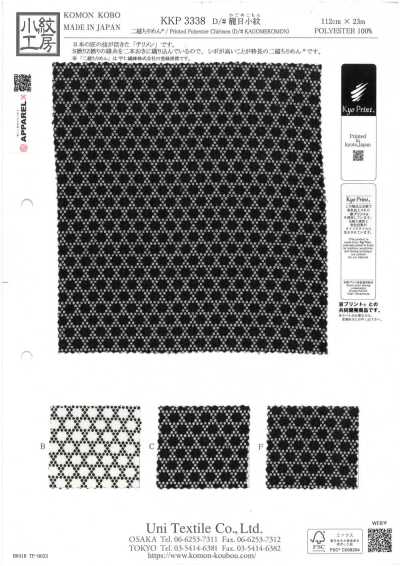
Kagome is a Japanese geometric pattern that stylizes the crossing diagonal lines seen in the weave of a bamboo basket, creating a continuous series of triangles and hexagons.

Contents6 sections
Definition and Overview
Kagome is a pattern in which diagonal lines cross at regular intervals, like the weave of a basket. Based on a series of connected equilateral triangles, it often features hexagonal mesh patterns and hexagram-like outlines, and is used as a Japanese geometric pattern.
In fabric, it is expressed by printing, yarn-dyed color arrangements, woven texture and raised-and-lowered surfaces, or Jacquard. Kagome is the name of a pattern and does not indicate a specific fiber material, weave structure, or dyeing method.
Pattern Origin and Naming
The name comes from the mesh of baskets made from bamboo, vines, and similar materials. The impression changes depending on the line thickness, crossing angle, color arrangement, and size of the motif; small versions look delicate, while larger ones have a graphic, striking appearance.
In product descriptions, it may be written as Kagome pattern, Kagome motif, or basket-weave-like or lattice-like. However, whether a simple lattice pattern or repeated hexagonal pattern is called Kagome depends on the expression of the design and its usage in the industry.
- Kagome that shows the mesh with single-color lines
- Kagome that highlights triangles and hexagons with color arrangement
- Kagome-like expressions that make use of the three-dimensional feel of weaving or knitting
Main Uses and Seasonal Feel
Kagome is used for kimono fabric and accessories, as well as shirts, blouses, dresses, skirts, bags, and interior applications. Because the size and color arrangement of the pattern can be adjusted easily, it can be incorporated into modern designs while retaining a Japanese feel.
The season is determined by the material, thickness, color, and finish of the fabric. Lightweight fabrics with pale colors are suited to spring and summer, while dark colors, brushed materials, and patterns with thick lines tend to create an autumn and winter impression.
Notes on Fabric Selection and Cutting
When selecting fabric, check the size of one side of the pattern, the pattern repeat, the direction of the pattern relative to the grainline, and the difference between printed and woven patterns. If the pattern is too large relative to the garment size or seam lines, the triangles or hexagons may be cut off partway and not appear as intended.
Before cutting, decide where the pattern should be matched, such as the center front, collar, front placket, pocket, and left and right body panels. In Kagome patterns with directional color placement or changes in appearance from top to bottom, parts may not be cut by reversing them, so allow extra fabric as needed.
- Check the intersections of lines and pattern placement on the left and right body panels and sleeves.
- Make sure the pattern does not break unnaturally at the center front, center back, or around the neckline.
- For pockets and facings, check that the pattern continues from the main body.
- Clearly specify the pattern-matching conditions in the specification sheet and cutting instructions.
Differences from Similar Terms
Asanoha is a pattern based on hexagons, with the interior formed by radial straight lines. Kagome is characterized by diagonal lines crossing continuously and appearing like the mesh of a basket. Both are straight-line Japanese patterns, but the way the lines connect is different.
Kikkō is a pattern made from repeated hexagons and does not focus on the continuous triangles or crossing mesh itself that define Kagome. Geometric patterns is a general term for patterns using triangles, grids, circles, and more, and Kagome is one specific pattern among them.
Frequently Asked Questions
How can Kagome be distinguished from Asanoha?
Kagome is a pattern in which diagonal lines cross continuously, forming connected triangles and hexagons like a basket weave. Asanoha uses a hexagonal base and creates a leaf-vein-like shape with straight lines radiating outward from the center. When selecting fabric, focus on the crossing lines and radial structure.
Does Kagome-pattern fabric require pattern matching?
If you want continuity at the center front, left and right body panels, pockets, seam lines, and similar areas, pattern matching is necessary. This is especially important with large Kagome patterns or patterns with colors, where misalignment becomes noticeable. Also check whether the pattern can be reversed top to bottom or left to right, and consider the required fabric length and placement before cutting.