Water-soluble Resin Interfacing
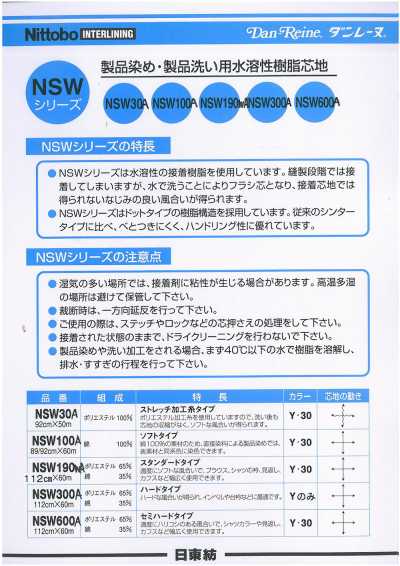
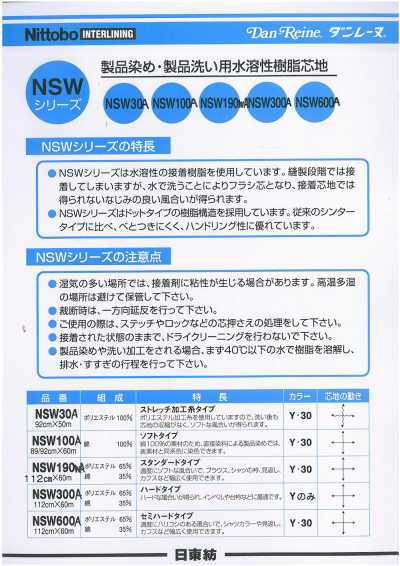
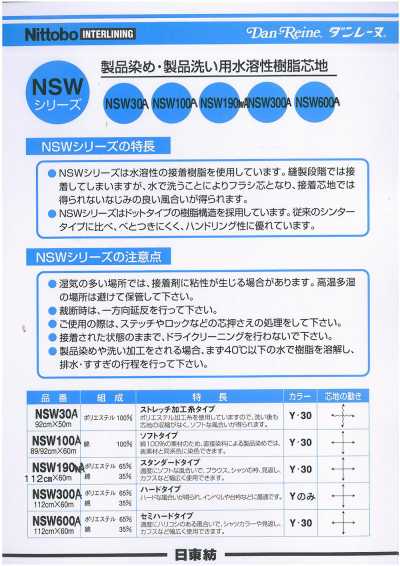
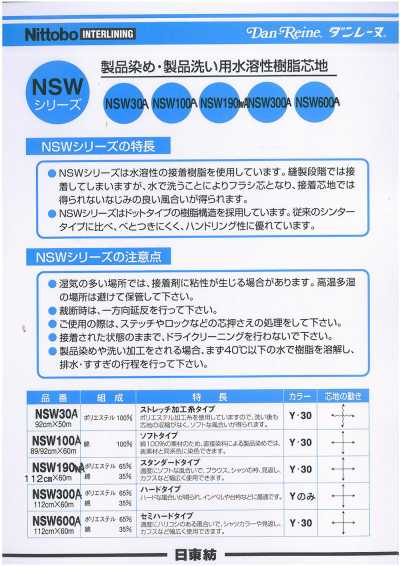
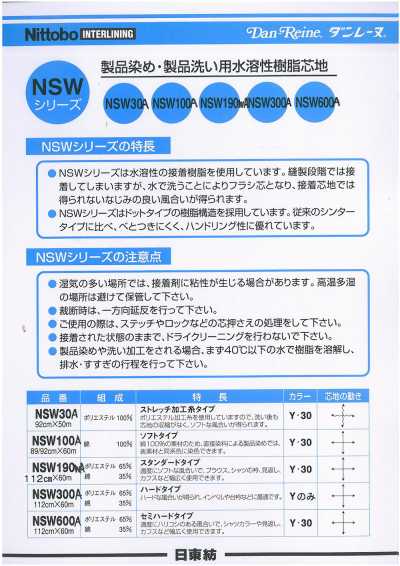
Water-soluble resin interfacing is a fusible interlining used for garments that are piece-dyed or garment-washed, taking advantage of the property that the adhesive resin dissolves or loses its effect during water or washing processes.
Contents6 sections
Definition and Overview
Water-soluble resin interfacing is an interfacing intended to be fused to the outer fabric to provide shape stability and reinforcement during sewing, while reducing the effect of the adhesive resin in later water washing or garment dyeing processes. It is considered for specifications that assume product finishing.
Conventional fusible interlining leaves the adhesive resin in place, bonding the outer fabric and interlining together. By contrast, water-soluble resin interfacing is characterized by uses in which a strong bonded state is not maintained after processing. However, the base fabric of the interfacing does not necessarily disappear.
Use Areas and Role
It is used in shirts, blouses, and lightweight garments that undergo garment dyeing or garment washing, in areas where shape should be maintained, such as the collar, collar stand, front placket, cuffs, and facings. It makes the outer fabric easier to handle during cutting and sewing before processing, and helps prevent stretching and distortion in those areas.
When post-processing appearance and softness are important, it is considered in cases where ordinary fusible interlining may leave stiffness or where appearance changes due to shrinkage differences between the outer fabric and interlining are a concern. Depending on the area where it is used, the texture of the base fabric remaining after processing also affects the final result.
Materials and Types
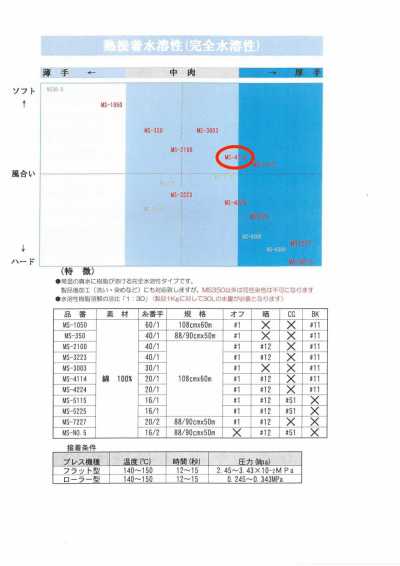
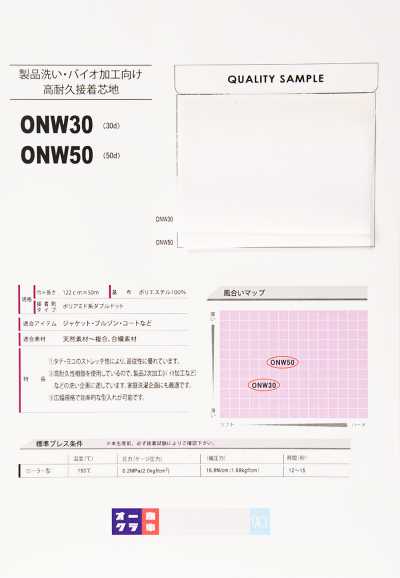
Interlining consists of a base fabric and adhesive resin. Base fabrics include nonwoven, woven, and knitted types, and choices include thin, soft, standard stiffness, and stretch-compatible types. The water reactivity of the resin is checked separately from the type of base fabric.
The name water-soluble resin interfacing mainly refers to the properties of the adhesive resin. Even with the same name, the degree to which resin is removed after processing, whether the base fabric remains, and suitability for washing conditions differ according to the specifications, so it is important not to judge performance by the name alone.
- Thin types are used for lightweight outer fabrics or fabrics where a light texture should be preserved.
- Soft types are suitable when excessive stiffness is not desired around the collar or front placket.
- Stretch-compatible types are designed to follow the movement of stretch outer fabrics.
Selection and Precautions
Choose based on the thickness of the outer fabric, stretch, weave or knit density, and the stiffness required after product finishing. Using a stiff interfacing on a thin fabric can make the outline or bond marks show through, while using a weak interfacing on a thick fabric may result in insufficient reinforcement. Check the finished look by layering the outer fabric and interfacing.
When bonding, press at a temperature, pressure, and time suitable for the resin. If the conditions are not right, initial adhesion may be insufficient, causing shifting during cutting or sewing. On the other hand, excessive heat or pressure can cause sheen, shrinkage, or changes in texture, so care is required.
Conditions for garment dyeing and garment washing vary depending on the water used, temperature, time, chemicals, and mechanical action. Before full production, make a trial sample using the same outer fabric, interfacing, and sewing specifications, and check for delamination, puckering, stiffness, and appearance after processing.
Differences from Similar Terms
Fusible interlining refers broadly to interlining that is bonded to the outer fabric by heat and pressure. Water-soluble resin interfacing is one type of fusible interlining, differing in that the properties of the adhesive resin are designed with water washing and product finishing in mind. Not all fusible interlining is suitable for garment dyeing or garment washing.
Temporary fusible interlining refers to interlining that is lightly bonded mainly for fixation during the process. Water-soluble resin interfacing may also be used for temporary bonding, but it is distinguished by its water reactivity. Haircloth interlining and non fusible interlining are interlinings used in tailoring without relying on thermal bonding in principle.
Frequently Asked Questions
Does water-soluble resin interfacing disappear completely after washing?
Not necessarily. Water-soluble mainly refers to the properties of the adhesive resin, and there are specifications in which the base fabric remains. The state of resin removal and whether the base fabric remains differ depending on the product design and washing or processing conditions. Check with a processing test in advance.
Can water-soluble resin interfacing be used for garments intended for ordinary home laundering?
Whether it can be used depends on the required shape retention and the bonded state after washing. Because the resin's function changes with water, it may not be suitable for uses that require the same durability as ordinary fusible interlining. Check the appearance and stiffness through tests in accordance with the care label.
How much stiffness should be selected for garment dyeing use?
Select based on the thickness of the outer fabric and the shape you want to retain in the collar or front placket after processing. For lightweight fabrics, consider a thin and soft type; for areas where shape should be created, consider a standard type. Since shrinkage and texture also change after processing, it is important to make a trial sample under actual processing conditions.